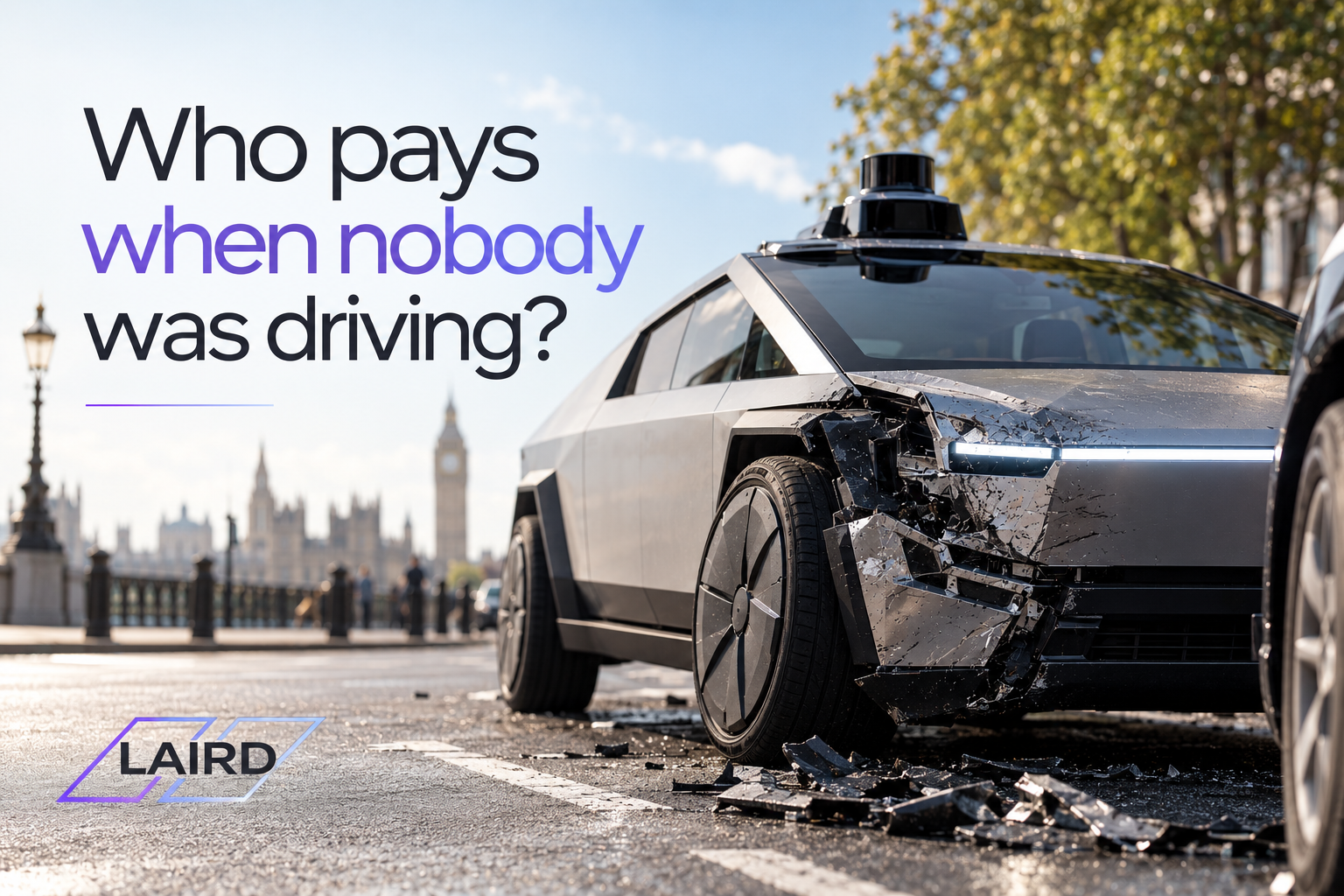
A recent collision on Las Vegas Boulevard offered a glimpse of a question the UK motor industry will increasingly have to answer.
On 25 September, a Nissan Murano was involved in a collision with an autonomous Zoox robotaxi. Nissan driver was taken to hospital while police investigated the incident. At the time of reporting, responsibility for the collision had not been established.
At first sight, it is simply another road traffic collision involving two vehicles, except one of those vehicles may have been making its own decisions.
For insurers, engineers and claims handlers, that changes rather more than the identity of the person, or computer, behind the wheel.
The UK has already started answering the liability question
Britain's approach is deliberately designed to avoid leaving an injured party attempting to establish whether a driver, vehicle manufacturer, software developer or autonomous system was ultimately at fault before obtaining compensation.
The Automated and Electric Vehicles Act 2018 places first-instance liability on the insurer where an insured automated vehicle causes an accident while driving itself. Importantly, that protection can also extend to the person occupying the automated vehicle. The insurer retains the ability to recover its outlay later from another party responsible for the accident.
That makes practical sense; imagine being struck by an autonomous vehicle and then having to determine whether its camera failed to identify you, its radar incorrectly measured your speed, the software selected the wrong manoeuvre or a previous repair left a sensor incorrectly calibrated before anyone would pay your claim.
The UK model is intended to allow the insurance process to deal with the victim first and investigate the underlying responsibility afterwards. The second part of that process is where things become considerably more complicated.
Who, or what, was actually driving?
The Automated Vehicles Act 2024 introduces a new legal structure around genuinely self-driving vehicles.
Where an authorised self-driving feature is operating, a human sitting in the driving seat can become a "user-in-charge". While the automated feature remains properly engaged, that individual is generally protected from responsibility for offences arising from the way the vehicle drives itself. If the system issues a valid demand for the person to retake control, responsibility can eventually pass back to the human driver.
Vehicles capable of operating without anybody in a position to drive them introduce another layer.
They will have an Authorised Self-Driving Entity, normally expected to be the organisation responsible for the automated driving technology, together with a licensed No User-in-Charge operator responsible for operational matters such as roadworthiness, maintenance and responding to incidents.
So the familiar claims question, "Who was driving?", could eventually become:
Was the automated system engaged? Was it authorised to operate in that location and those conditions? Had it issued a request for the human to take control? Was the vehicle being properly maintained? Did the automated driving system perform as intended? Those questions will need evidence.
The accident report of the future could look very different
Traditional accident investigation combines accounts from the drivers, photographs, CCTV, physical damage, road evidence and, where appropriate, data such as an event data recorder.
An automated vehicle potentially adds an enormous additional evidential layer.
Insurers are already calling for access to a minimum dataset following automated vehicle collisions. The Association of British Insurers has said access to relevant vehicle data will be fundamental to efficiently resolving claims and ensuring victims receive compensation.
That data could establish whether the automated system was active, how fast the vehicle was travelling, whether it detected another road user, when braking began, what steering input was commanded and when, or whether control had been requested from a human occupant.
At first glance, that might suggest accident investigation becomes easier. and perhaps it does in some respects, but computer data still describes what the vehicle's systems recorded and what the software instructed the vehicle to do. Someone may still need to establish whether that account agrees with the physical evidence.
Cars can record a version of events, but they cannot inspect themselves after the event
Imagine an autonomous vehicle records that it detected another car, braked heavily, steered left and collided at 18mph.
An engineer subsequently examines the vehicles and finds a crush pattern, wheel displacement or structural loading that appears inconsistent with that sequence. That raises further questions. Was the electronic evidence complete? Did the sensors correctly perceive the environment? Was there an earlier impact? Was a component already damaged? Does the physical evidence support the recorded direction and severity of the collision?
Vehicle engineering does not disappear simply because more data becomes available. Arguably, the additional data makes independent physical verification more important.
For assessors, accident investigators and expert engineers, the job increasingly becomes one of comparing two bodies of evidence: what the vehicle says happened and what the vehicle itself shows happened.
Damage will matter beyond the repair estimate
There is another issue which deserves considerably more attention.
Modern vehicles already rely heavily on cameras, radar, ultrasonic sensors and increasingly sophisticated ADAS systems. Automated vehicles take that dependency much further.
Consider a relatively modest front-corner impact.
The obvious damage might be a bumper, wing and wheel. Behind those components could sit a radar unit, mounting brackets, cameras and other sensors. The impact could also have travelled through the wheel into the hub, bearing, suspension, steering or subframe.
Some of that damage may be visually obvious; some may not.
Our own work at Laird analysing large volumes of supplementary repair items has repeatedly demonstrated how accident damage can extend beyond the components initially visible in photographs. Brackets, suspension components, diagnostic requirements, geometry and calibration can emerge later in the repair process.
On a conventional vehicle, missing one of those items can produce an incorrect repair estimate or delayed repair. On an automated vehicle, an apparently minor defect could potentially influence one of the systems upon which the vehicle relies to perceive the road. The engineering question therefore starts to move beyond, "how much will this vehicle cost to repair?" It may also need to consider, "has anything occurred during this collision which could compromise the vehicle's ability to operate its automated systems safely?"
That represents a significant change in emphasis for claims engineering.
Previous repairs may become part of future liability investigations
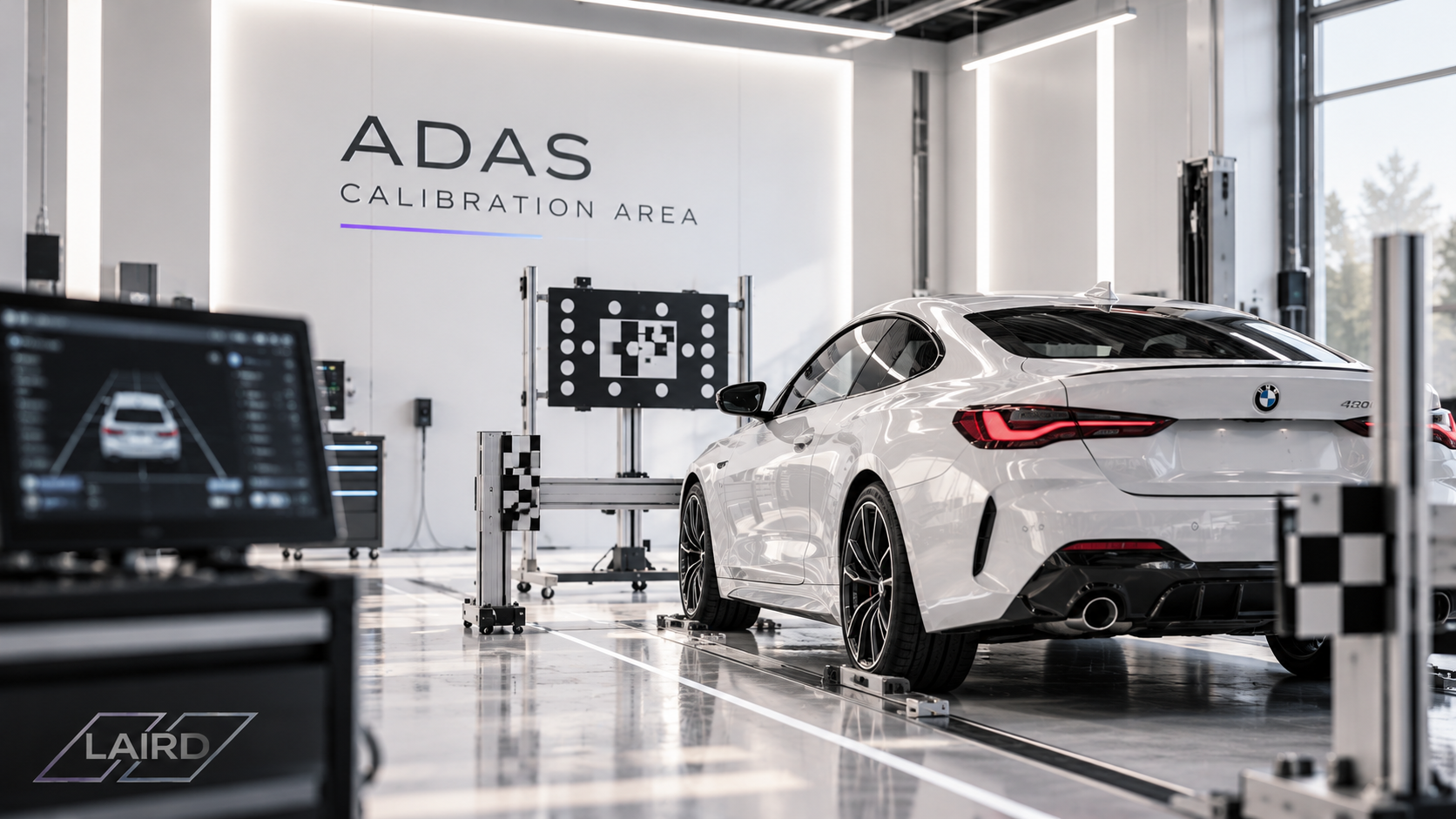
There is another scenario which could become particularly contentious. An autonomous vehicle is involved in a serious accident. Investigation subsequently identifies that one of its ADAS radar units was misaligned. The immediate suspicion may fall on the autonomous driving system or vehicle manufacturer.
Further investigation then discovers that the vehicle suffered a relatively minor collision eight months earlier.
Was the radar bracket replaced? Was it repaired? Was the ADAS calibration carried out correctly? Was the appropriate manufacturer repair method followed? Was damaged supporting structure overlooked?
Suddenly a collision claim could require examination of the vehicle's entire previous repair history. The resulting recovery action might ultimately involve insurers, manufacturers, fleet operators, repairers, calibration providers and component suppliers.
Independent engineering evidence could become important long after the original repair invoice has been paid.
Regulation is now moving from theory towards deployment
This is not quite an issue for some distant autonomous future. The Automated Vehicles Act received Royal Assent in 2024, and the Government intends the wider regulatory framework to be fully implemented in the second half of 2027.
The Automated Vehicles (Permits for Automated Passenger Services) Regulations 2026 have already created a route for automated passenger services in Great Britain. The framework allows commercial passenger services to develop ahead of the complete 2027 regime, subject to the relevant approvals and safeguards.
Government guidance on automated vehicle trials was also updated in June 2026 as Britain continues to encourage real-world development of the technology.
The question for insurers and the wider claims industry is how quickly the existing claims infrastructure needs to adapt.
The engineer still has a role, but it will evolve
Automation will provide insurers with quantities of vehicle information that would have been unimaginable in a traditional motor claim, which is welcomed. Good data can remove uncertainty, expose inaccurate accounts and accelerate sensible liability decisions, but digital evidence and physical evidence answer different questions.
The automated system may be able to tell an insurer when braking was commanded. An engineer can examine whether the collision damage is consistent with the resulting movement.
The vehicle may report that its radar remained operational. Someone may still need to establish whether the radar mounting point has moved following an impact. The software may record an 18mph collision. Physical inspection can establish what was actually damaged by it, and an automated estimate may identify what can be seen in photographs, while further engineering assessment considers what may have happened behind those visible components.
Motor claims have always relied upon the relationship between evidence, engineering judgement and the circumstances of an accident. Driverless vehicles simply add another exceptionally sophisticated witness, and, like any witness, its evidence still needs to be tested.