As vehicle technology becomes more sophisticated, accident repairers face a growing challenge: identifying which driver assistance systems may have been affected by a collision, determining what work is necessary and, crucially, demonstrating that those systems have been restored to the manufacturer's specification.
For bodyshops, insurers and accident management companies, ADAS is increasingly influencing repair methodology, estimating accuracy, key-to-key times and repair costs. It is also creating questions about responsibility, particularly where diagnostic work, calibration and verification are undertaken by different organisations.
The technology itself is well established. What continues to evolve is the complexity of repairing vehicles equipped with it, alongside the equipment, technical information and specialist knowledge needed to do so safely.
The repair can affect more than the damaged components
One of the difficulties with ADAS in accident repair is that the visible extent of damage does not necessarily indicate the extent of the technical work required.
A relatively minor frontal impact may damage a bumper cover without visibly affecting the radar sensor behind it. However, the impact could have disturbed its mounting bracket, altered its alignment or affected the components through which the sensor operates.
Similarly, repairs involving windscreens, suspension, steering, body structure or vehicle ride height can have implications for camera and radar alignment, even where the sensors themselves have not been replaced.
The consequences are not always immediately apparent. A system may continue operating without illuminating a warning lamp, yet its performance could have been compromised by an incorrect sensor angle, unsuitable mounting position or another deviation from the manufacturer's specification.
This creates an important distinction for repairers: a system that appears to be functioning is not necessarily a system that has been correctly calibrated or verified.
It also challenges traditional approaches to damage assessment. A VDA or estimator may identify every visibly damaged component while overlooking the diagnostic, calibration and verification operations necessary to complete the repair.
The result can be an estimate that accurately reflects the physical damage but understates the full cost of returning the vehicle to its pre-accident condition.
When are pre-repair and post-repair diagnostic checks required?
There remains considerable confusion around the terminology of pre-scans, post-scans, system checks and ADAS calibration. Although these activities are related, they serve different purposes and should not be treated as interchangeable.
A pre-repair diagnostic scan establishes an electronic record of faults and system status before repairs commence. It may identify stored diagnostic trouble codes, communication faults, sensor failures and other issues that are not immediately evident during a visual inspection.
Importantly, it can help distinguish between faults recorded before the repair process and those arising during or following it. It does not, however, establish conclusively that every recorded fault was caused by the accident.
A post-repair diagnostic scan provides evidence of the vehicle's electronic status after the work has been completed. It can identify unresolved faults, problems introduced during repairs and systems requiring further attention.
Neither scan should be confused with calibration. A diagnostic tool may report no active faults while a camera or radar sensor still requires a specific alignment or calibration procedure.
The UK's Insurance Industry Requirements (IIR), developed by Thatcham Research, establish a framework for identifying ADAS equipment and determining the necessary inspection, realignment and calibration operations.
The requirements apply where repairs involve ADAS sensors, components that could influence their operation, or vehicle geometry. Repairers are expected to follow the relevant vehicle manufacturer's technical procedures and maintain verifiable records of the work undertaken.
The important qualification is that there is no single universal rule requiring every vehicle to undergo every available diagnostic and calibration procedure following every accident.
The necessary operations depend on the vehicle, its equipment, the nature of the damage, the repairs undertaken and the manufacturer's instructions.
Equally, the absence of a dashboard warning or diagnostic fault code should never be regarded as sufficient evidence that calibration is unnecessary.
For bodyshops, a defensible approach is to establish the vehicle's ADAS specification at initial assessment, obtain the relevant manufacturer repair information and identify the required diagnostic and calibration operations before authorising the repair plan.
That approach reduces the likelihood of discovering additional technical requirements only when the vehicle is approaching completion.
Sources: Thatcham Research, Insurance Industry Requirements, Thatcham Research, ADAS calibration training.
Calibration is not always a straightforward operation
ADAS calibration is frequently discussed as though it were a single process, but the procedures vary considerably between manufacturers and vehicle systems.
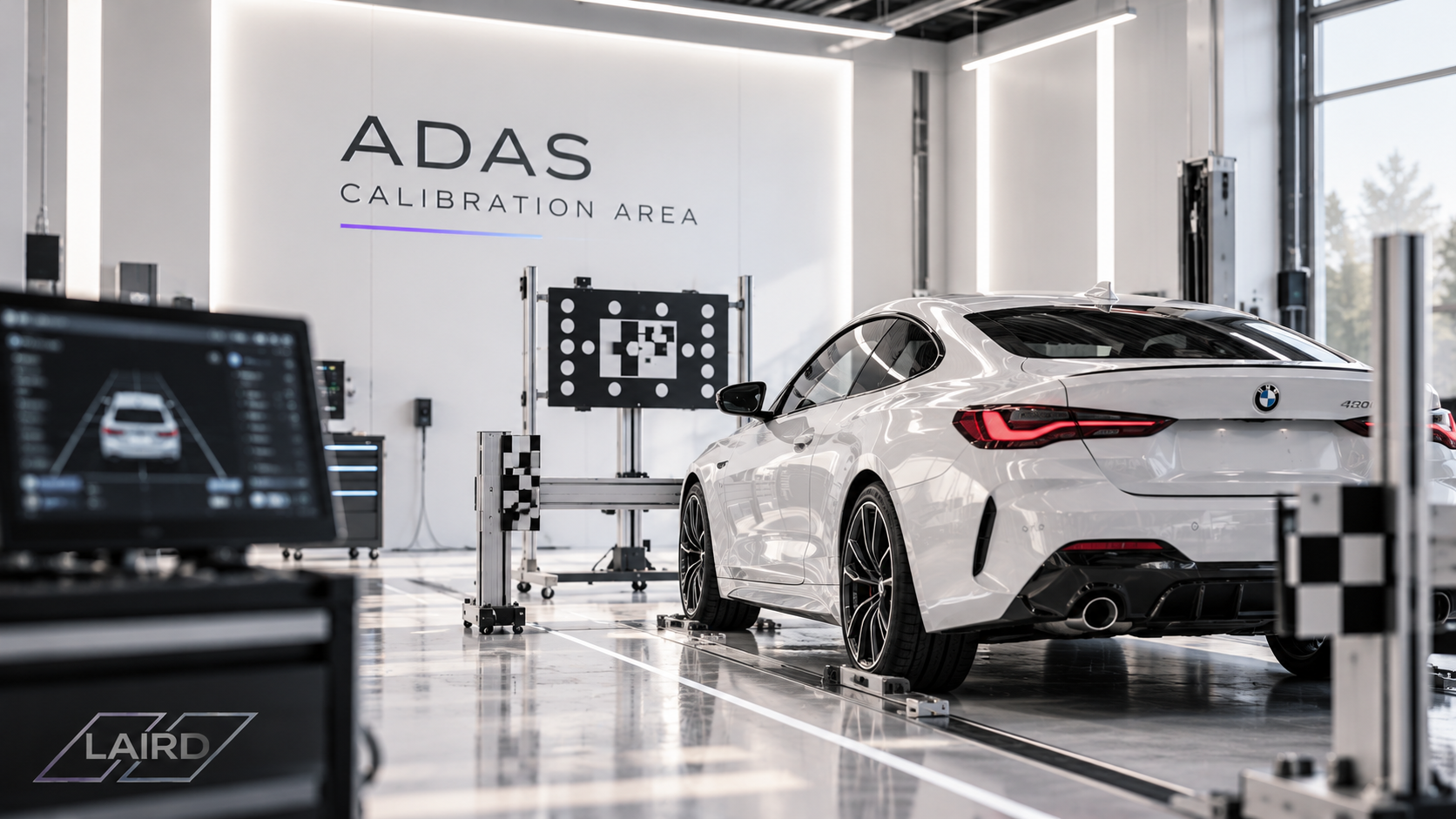
Static calibration generally requires the vehicle to be positioned accurately in relation to specialist targets, reflectors or calibration equipment. The procedure will generally require a level floor, prescribed tyre pressures, appropriate vehicle loading, verified suspension geometry and precise distances between the vehicle and calibration targets.
Dynamic calibration involves driving the vehicle under specified conditions, potentially including minimum speeds, suitable road markings, adequate visibility and particular traffic or environmental conditions.
Some manufacturers specify static calibration, others dynamic calibration, and certain vehicles require a combination of both.
This creates practical difficulties for bodyshops, particularly those operating in congested premises or areas where suitable roads are not readily available.
Even where the necessary diagnostic equipment is available, an unsuitable calibration environment can prevent the procedure from being completed correctly.
Vehicle geometry is another consideration. If the suspension or steering alignment is outside specification, calibrating a camera or radar sensor against that incorrect geometry may produce an unsatisfactory result.
Consequently, wheel alignment, ride-height verification and other mechanical checks may need to precede ADAS calibration.
For repair managers, this is primarily a sequencing issue. Calibration should be incorporated into the repair methodology rather than treated as an isolated task at the end of the process.
A calibration appointment arranged before the vehicle is mechanically and geometrically ready can result in wasted labour, repeat work and avoidable delays.
The estimating problem: recognising the latent operations
ADAS presents a particular challenge for vehicle damage assessors because many of the necessary operations are not apparent from photographs.
A photograph may clearly establish that a bumper requires replacement, but it cannot reliably establish whether a radar bracket has moved, whether the mounting structure remains within tolerance or whether calibration will be necessary following reassembly.
Similarly, damage to a wing or suspension component may appear relatively straightforward until the manufacturer's repair procedure identifies additional checks associated with steering geometry, camera alignment or other interconnected systems.
This is especially relevant to desktop estimating, where the engineer may have no physical access to the vehicle.
The correct response is not to assume that every vehicle requires extensive calibration. Nor is it appropriate to omit the operations simply because they cannot be confirmed visually.
Instead, the estimate should distinguish between operations known to be required, those conditional upon inspection findings and those dependent on the manufacturer's prescribed repair methodology.
Where necessary, appropriate allowances can be identified and the estimate qualified pending physical inspection, diagnostic assessment or further technical information.
For insurers and accident management companies, this is an important distinction. An estimate that excludes necessary ADAS operations may initially appear more economical, but subsequent supplements can increase the final repair cost and extend the period of vehicle hire.
Accurate early identification of these requirements can therefore be as important commercially as it is technically.
What has changed in 2026?
Several developments illustrate how quickly ADAS is becoming a mainstream operational consideration rather than a specialist activity.
In July 2026, Auto Windscreens reported that its ADAS calibration volumes had increased by 30% over the preceding year. More than 40% of its front windscreen replacement jobs now involve calibration.
The company also identified the growing number of Chinese-manufactured vehicles entering the UK market as a contributing factor.
For accident repairers, the significance extends beyond glazing. Greater diversity in vehicle manufacturers introduces additional calibration procedures, software requirements and potential gaps in equipment coverage.
The expanding presence of brands such as BYD, MG and Geely is particularly relevant. Repairify announced an expansion of its ADAS diagnostic capabilities in February 2026 in response to the increasing number of Chinese vehicles on UK roads.
Bodyshops considering investment in calibration equipment therefore need to look beyond the vehicle manufacturers traditionally dominating their repair volumes.
A system that adequately covers today's vehicle mix may not necessarily provide the same coverage in three years.
Calibration equipment is becoming more sophisticated
One of the more interesting developments is the increasing automation of the calibration process itself.
In July, Hella Gutmann completed the first UK installation of its CSC-Tool PRO at Auto Windscreens' training centre in Chesterfield.
The equipment uses an 86-inch digital display instead of conventional calibration boards, retrieves vehicle-specific calibration targets through a cloud connection and guides technicians through the setup procedure.
Crucially, it also incorporates checks intended to verify that the necessary setup conditions have been satisfied before calibration can proceed.
The system produces a digital record linking the diagnostic scans, calibration parameters and completed procedure.
Bosch's DAS 3000 range similarly incorporates computer-assisted calibration, with equipment available for camera, radar and surround-view applications.
Meanwhile, Hunter Engineering announced an expansion of its ADASLink diagnostic platform in September 2026, integrating remote diagnostic support from Bosch. This provides access to specialist assistance with manufacturer software, calibration, coding and repair verification.
These developments point towards a broader change in workshop equipment.
Calibration technology is increasingly being designed to reduce setup errors, improve efficiency and produce more comprehensive evidence of the work undertaken.
However, automation should not be confused with independence from the manufacturer's technical requirements. The equipment remains dependent on correct vehicle identification, suitable working conditions, appropriate software and competent operation.
A successful result displayed by a diagnostic system is only meaningful when the correct procedure has been selected and its prerequisites satisfied.
In-house calibration or specialist subcontracting?
For bodyshop operators, the commercial question is whether ADAS calibration should be undertaken internally or entrusted to specialist providers. There are credible arguments for both approaches.
An in-house facility offers greater control over scheduling, reduces dependence on third-party availability and potentially allows calibration to be incorporated more efficiently into the repair process.
For larger repair centres with sufficient throughput, investment in equipment and technician competence may be commercially attractive. However, the costs extend beyond the initial purchase of calibration equipment.
Dedicated space, floor conditions, alignment equipment, software subscriptions, technical information, training, accreditation and continuing support must all be considered.
There is also the question of manufacturer coverage. Purchasing a calibration system does not automatically establish that every vehicle entering the workshop can be calibrated using that equipment.
For smaller or medium-sized bodyshops, specialist subcontracting may provide a more practical solution, particularly where repair volumes do not justify the investment.
In May 2026, Bodyshop Magazine reported on independent repairer Car Fix Solutions, which had integrated external calibration and remote diagnostic specialists into its everyday workflow. The business attributed improvements in its repair capability and efficiency to that arrangement.
The important consideration is not necessarily whether the work is performed internally or externally, but whether the chosen arrangement provides reliable access to the required expertise, appropriate equipment and complete supporting documentation.
Subcontracting does not remove the repairer's responsibility to ensure that the work has been completed correctly.
A bodyshop should therefore be satisfied that its calibration provider can identify and follow the appropriate manufacturer procedures, demonstrate technician competence and provide auditable evidence of the results. For work providers, the same questions should form part of repair network oversight.
The documentation may become as important as the calibration
As ADAS becomes more complex, the quality of the repair record is assuming greater significance.
BS 10125:2022, the current British Standard covering vehicle damage repair processes, addresses the reinstatement of vehicle systems, personnel competence, equipment, repair process management and record keeping.
The standard also includes updated technical provisions concerning ADAS and other advanced vehicle technologies.
Thatcham Research's Insurance Industry Requirements specify that inspection, realignment and calibration operations must be supported by verifiable, auditable records.
Those records are intended to establish that the relevant systems have been returned to the manufacturer's technical specification.
For a repairer, an appropriate record may include the vehicle identification, the manufacturer's applicable procedure, diagnostic findings, calibration equipment and software used, relevant setup measurements, the calibration outcome and details of the person undertaking the work.
Where a procedure could not be completed, the reason and subsequent action should also be recorded. This is particularly important where a vehicle changes hands between the bodyshop, a diagnostic specialist, a calibration provider and the customer. The documentation needs to demonstrate a coherent sequence of technical decisions and completed operations.
A calibration invoice alone is unlikely to provide the same level of assurance as a comprehensive record showing precisely what was undertaken and whether the required results were achieved.
The issue becomes especially relevant if the vehicle is subsequently involved in another collision and questions arise about the performance of its safety systems.
At that point, the ability to demonstrate compliance with the manufacturer's repair methodology may be considerably more valuable than a general assurance that the vehicle was checked before release.
The emerging challenge for insurers and accident management companies
For insurers and AMCs, ADAS presents several interconnected challenges.
The first is estimating accuracy. Diagnostic and calibration requirements need to be recognised early enough to avoid unnecessary supplements and delays.
The second is repair network capability. A repairer may be highly competent in structural and cosmetic repairs while having limited access to particular manufacturer diagnostic or calibration procedures.
The third is consistency. Different repairers may interpret the same vehicle's requirements differently, particularly where technical information is difficult to access or the repair involves multiple systems.
Finally, there is the question of cost control.
ADAS-related operations can increase repair expenditure, but omitting necessary procedures creates its own financial and technical risks.
The commercial objective should therefore be to identify the correct operations and ensure they are completed efficiently, rather than applying either blanket calibration requirements or blanket exclusions. There is an opportunity here for insurers and AMCs to improve their repair authorisation processes.
An estimate accompanied by the relevant manufacturer methodology, a clear explanation of required calibration operations and an appropriate diagnostic plan should be easier to assess than a supplementary invoice received several days after the physical repair has been completed.
Repair networks could also benefit from more consistent requirements concerning diagnostic records, calibration documentation and subcontractor competence.
Such measures would improve transparency without unnecessarily prescribing how individual bodyshops organise their technical operations.
Skills remain a significant constraint
Equipment investment alone will not resolve the industry's ADAS challenges. In February 2026, Thatcham Research published findings from research undertaken with the Centre for Economics and Business Research. Some 73% of surveyed repair and salvage professionals identified the widening skills gap as a growing challenge.
Thatcham also reported that average collision repair costs increased by 50% between 2019 and 2024, with technological advancement and the specialist skills required to repair modern vehicles contributing to that increase. ADAS is part of that wider problem.
Technicians must increasingly understand the interaction between electronic systems, vehicle geometry, structural repairs and manufacturer-specific procedures.
Vehicle damage assessors also require sufficient technical understanding to recognise when seemingly straightforward damage could have implications for electronic safety systems. This does not mean every VDA needs to become an ADAS calibration technician.
It does mean that repair organisations need effective communication between estimating, mechanical, structural and diagnostic disciplines. A technically correct repair plan is difficult to produce when those functions operate independently. Training therefore needs to extend beyond the individuals operating calibration equipment.
Repair planners, estimators, quality controllers and those authorising repairs all have a role in identifying the necessary work and understanding the implications of omitting it.
A practical approach for repairers
For bodyshops reviewing their existing ADAS procedures, the most useful starting point is an examination of how technical requirements are identified and managed throughout the repair.
Five questions are particularly relevant:
1. Identification: Are the vehicle's ADAS systems identified during initial assessment, including equipment that may not be immediately apparent from the vehicle's appearance?
2. Repair methodology: Are current manufacturer procedures consulted to determine the necessary inspections, diagnostic operations and calibration requirements?
3. Repair planning: Are those operations incorporated into the estimate and workshop schedule early enough to avoid unnecessary supplements and delays?
4. Technical capability: Can the required procedures be completed using appropriately qualified personnel and suitable equipment, whether internally or through an approved specialist?
5. Verification: Does the completed repair file contain sufficient evidence to demonstrate that the necessary operations were undertaken and the results were satisfactory?
These questions are also relevant to insurers and accident management companies assessing the technical capability of their repair networks. A useful measure of performance would be the proportion of ADAS-related operations identified during initial estimating compared with those subsequently added during repair.
Other meaningful indicators could include calibration completion rates, repeat calibration attempts, delays attributable to specialist availability and the completeness of supporting documentation. Such information could help distinguish unavoidable technical complexity from inefficiencies in the repair process.
The next challenge is managing the whole repair, not just the calibration
ADAS is already influencing how vehicles are assessed, repaired and returned to service. As the vehicle parc continues to evolve, its significance will increase.
The industry is also moving towards more sophisticated diagnostic and calibration equipment, with improved automation, remote technical support and digital verification.
These developments should help repairers manage increasingly complex vehicles, but they will not eliminate the need for sound engineering judgement.
For bodyshops, the priority is to recognise ADAS implications early, plan the necessary operations correctly and retain adequate evidence of their completion.
For insurers and accident management companies, it is to ensure that repair authorisation and cost-control processes recognise the technical requirements of modern vehicles without encouraging unnecessary work.
Ultimately, the quality of an accident repair cannot be judged solely by the condition of the repaired bodywork or the absence of dashboard warning lights.
The completed vehicle must also meet the manufacturer's relevant technical requirements, with sufficient evidence to demonstrate how that conclusion was reached.
That is becoming an increasingly important measure of repair quality, and one that deserves attention from everyone involved in the accident repair process.