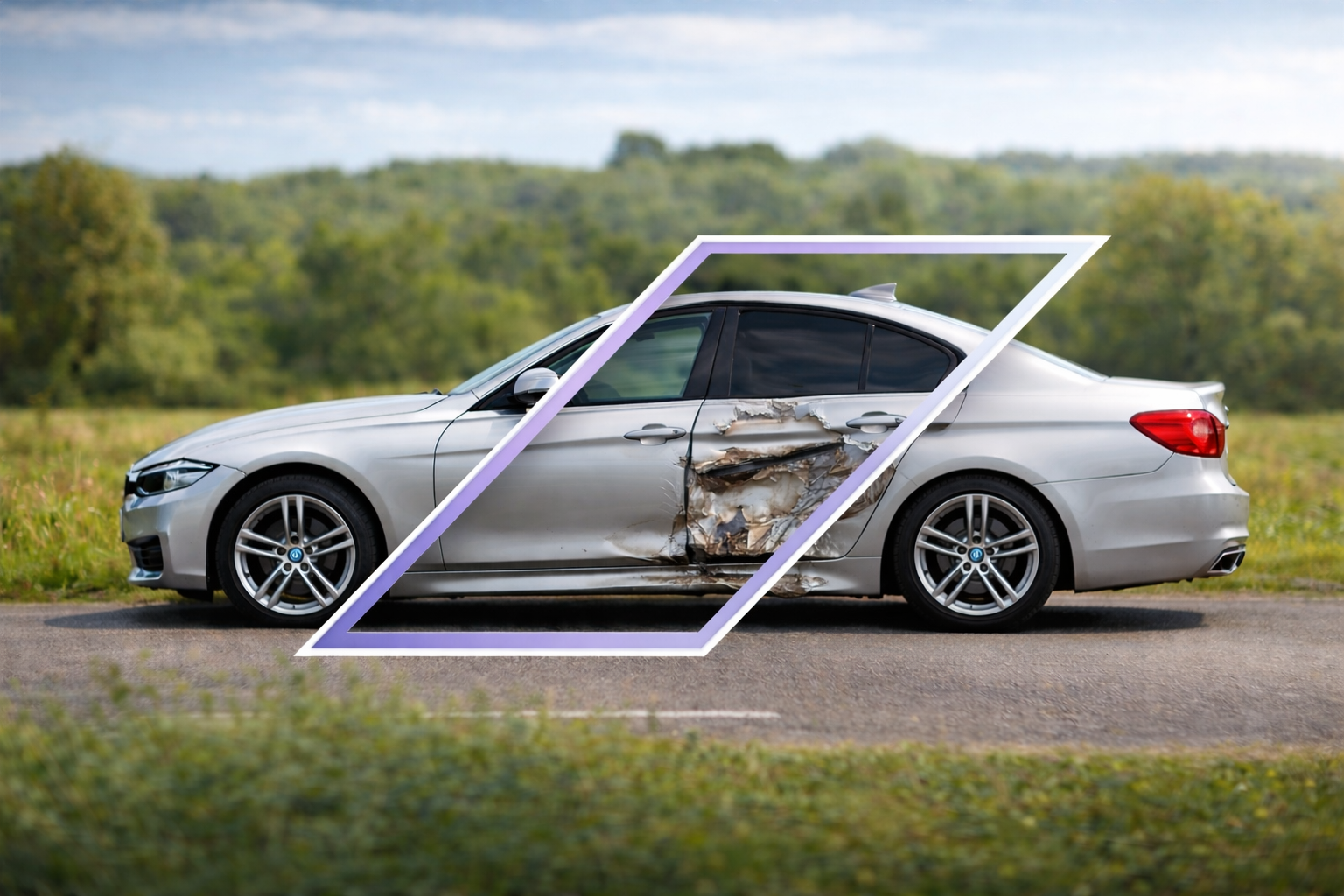
The camera never lies, until it does, and increasingly, it is being engineered to do so.
In motor claims, photographic evidence has historically been treated as a reliable proxy for truth. That assumption is now fundamentally flawed. AI-assisted image manipulation, generative fill tools, and low-friction editing platforms allow damage to be exaggerated, synthesised, or selectively enhanced with minimal effort and no obvious visual trace. The downstream impact is systemic, inflating indemnity costs, distorting liability positions, and introducing friction across insurers, accident management companies, and both claimant and defendant legal channels. Fraud at this level is not a victimless exercise, it degrades the integrity of the entire claims process.
From a forensic engineering perspective, images must now be assessed as data artefacts with measurable integrity, provenance, and internal consistency.
Fraud Signals
The first layer of validation is metadata interrogation. EXIF datasets provide capture timestamps, geospatial coordinates, device identifiers, lens parameters, and encoding histories. These attributes are cross-referenced against the reported loss event. Temporal drift, GPS mismatch, or device inconsistency across a single claim set are early-stage indicators of potential manipulation or substitution.
The second layer introduces cryptographic provenance. Increasingly, image authenticity can be validated through cryptographic hashing, digital signatures, and emerging content authenticity standards such as C2PA. Where an image has been signed at point of capture, its integrity can be verified end-to-end, confirming that no post-capture modification has occurred. In the absence of native signing, hash comparisons across file iterations can still detect alteration at a binary level, even where visual changes are imperceptible.
Conversely, the absence or degradation of metadata remains a key risk indicator. Screenshots, re-encoded files, and images transmitted via messaging platforms frequently strip or overwrite EXIF data. This breaks the evidential chain of custody and elevates the requirement for deeper forensic scrutiny.
At pixel level, forensic techniques extend further. Error Level Analysis (ELA), sensor pattern noise (SPN) comparison, JPEG quantisation analysis, and detection of generative artefacts can all indicate tampering. AI-altered regions often exhibit inconsistencies in noise distribution, edge continuity, or compression signatures. Cloning detection algorithms can identify duplicated pixel regions, while frequency domain analysis can expose synthetic image construction.
However, technical signals alone are insufficient. Damage must comply with mechanical reality. Impact vectors, energy transfer, panel deformation, material response, and paint interaction must align with the reported mechanism of loss. This is where our engineering expertise is decisive. An image may pass superficial digital checks, but if the damage profile is not physically plausible, it cannot be relied upon.
Contextual validation provides an additional layer. Environmental factors, including shadow vectors, weather conditions, road surface characteristics, and background topology, must correlate with the stated time and location. Increasingly, geospatial cross-referencing and scene reconstruction techniques can be used to validate whether an image could realistically have been captured as described.
Looking forward, the industry is moving towards controlled capture environments. Secure mobile capture applications, real-time image signing, blockchain-backed registries, and live video validation workflows are all emerging as mechanisms to establish trusted image provenance at source rather than attempting to reconstruct it retrospectively.
Top 5 Red Flags in Suspect Claim Images:
* Missing, inconsistent, or overwritten EXIF metadata
* Evidence of re-encoding, screenshots, or loss of original file structure
* Pixel-level anomalies, cloned regions, or compression inconsistencies
* Damage profiles that do not align with impact physics or vehicle construction
* Environmental or contextual elements that conflict with the reported incident
The practical implication is clear. Image validation must be multi-layered, combining metadata analysis, cryptographic verification, pixel-level forensics, and engineering assessment. No single control is sufficient in isolation.
At Laird, we approach image authentication as a dedicated forensic discipline within the claims process. We work with insurers and accident management companies to assess the integrity, provenance, and plausibility of submitted imagery, providing clear, defensible opinions on whether evidence can be relied upon. This capability sits alongside our core engineering services as an additional layer of fraud mitigation, designed to support more accurate, more confident claims outcomes.
Because as image manipulation becomes more sophisticated, the response cannot be reactive. It has to be engineered, controlled, and applied with the same level of rigour as the fraud it is designed to detect.