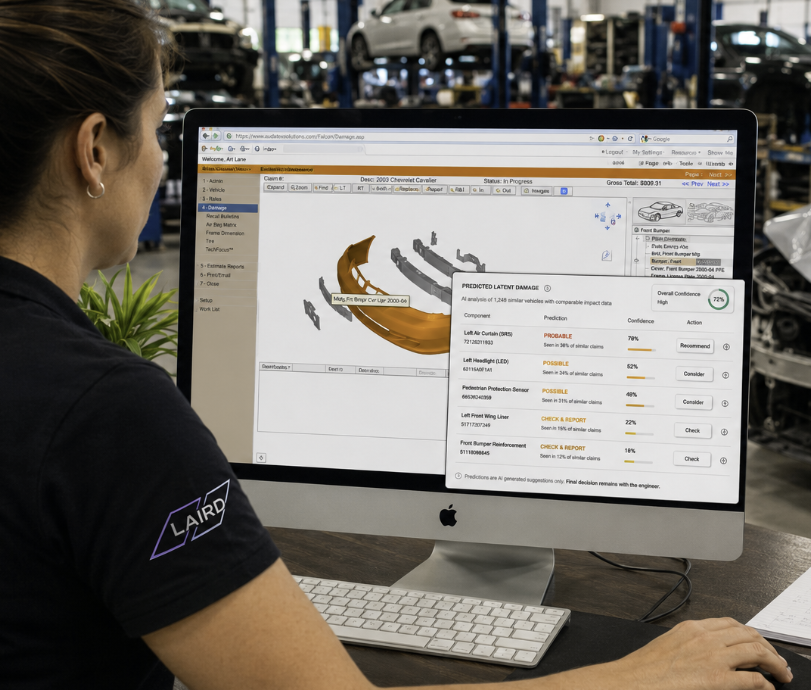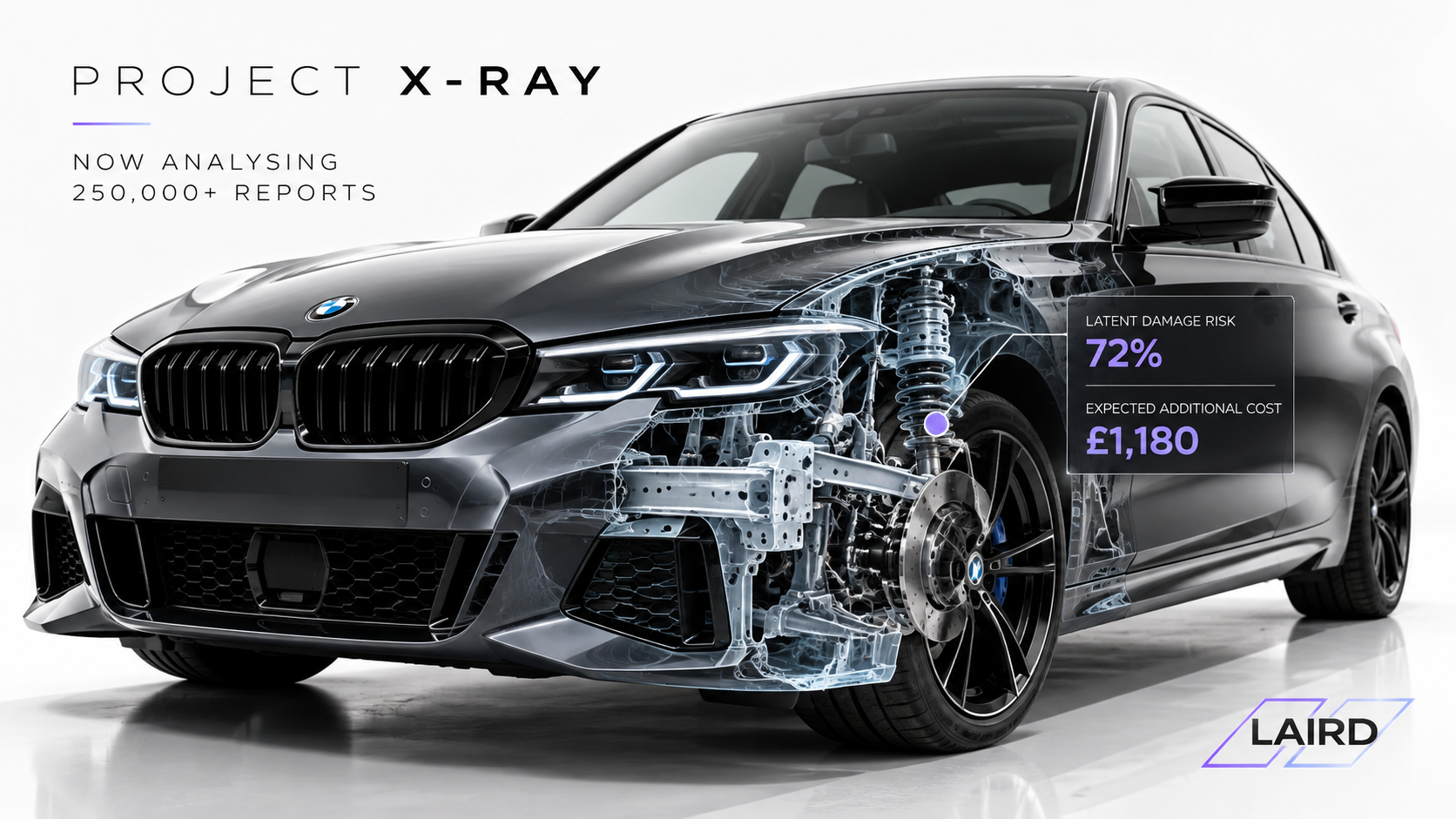
Project X-Ray has now ingested more than 250,000 accident damage reports. At that scale, patterns become clearer, but so do the limitations.
When we first started analysing supplementary repair estimates, one of the obvious opportunities was to identify individual components which frequently appeared later in the repair process but had been missed from the original assessment. With enough historic cases, it appeared reasonable to ask whether a system could look at the visible damage and say, in effect, “you may also want to check this component”.
It can, but the difficulty is achieving the level of precision required to do that responsibly across the UK vehicle parc.
A BMW 3 Series is not simply a BMW 3 Series. Across generations, model years, derivatives, engines, trim levels, optional equipment, specification changes and mid-cycle updates, the number of possible configurations becomes enormous. Multiply that across virtually every make and model on the road and even a quarter of a million accident reports becomes a relatively modest dataset.
Our present view is that genuinely reliable component-by-component prediction would require perhaps 100 times the data we currently hold.
It's important because false confidence is arguably more dangerous than no prediction at all. An assessor presented with a suggested component may be tempted to select it because the system has prompted them, rather than because the physical evidence justifies it. For experienced VDAs and engineers, technology should improve judgement, not quietly replace it.
So Project X-Ray is evolving around the areas where the data is proving considerably stronger.
From predicting parts to predicting risk
Rather than concentrating primarily on whether a particular bracket, hub, sensor or suspension component is likely to be required, we can look much more broadly at the historic financial behaviour of comparable accidents.
That allows X-Ray to ask questions such as:
* How frequently does damage of this type generate additional repair cost?
* How large is that additional cost normally likely to be?
* How does the initial estimate compare with previous vehicles presenting a similar damage profile?
Imagine, for example, that an initial estimate is prepared for a particular generation of BMW 3 Series following a front-quarter impact.
Rather than telling the estimator that a specific unseen component definitely requires replacement, X-Ray might say:
Of the last 100 closely comparable BMW 3 Series claims with damage in this area and of this severity, 72% generated supplementary repair costs. The average additional cost was £1,180. This estimate is materially below the historic range, so further inspection is recommended.
That is a different type of assistance. It gives an engineer, insurer or repairer useful intelligence without pretending that software can see through metal.
The financial prediction is becoming more interesting than the parts prediction
The larger the dataset becomes, the more useful the relationship between initial estimate value and eventual repair cost becomes.
Project X-Ray can increasingly identify combinations of vehicle, damage position, severity and estimate value which historically produce disproportionate supplementary spend.
That creates several useful outputs.
A claim might have a relatively low probability of significant latent damage and can proceed normally.
Another might carry a high supplementary-risk score because similar repairs consistently cost substantially more than their initial estimates.
A third might look relatively innocuous visually but sit within a category where historic repair outcomes indicate a high likelihood of additional structural, suspension, diagnostic or ADAS work.
The aim is therefore becoming less about automatically writing the missing lines of an estimate and more about knowing where an estimate deserves another look before it becomes a problem downstream.
Connecting X-Ray to Visual Intelligence
That development also makes Project X-Ray particularly relevant to the growing number of Visual Intelligence and instant-triage platforms entering motor claims.
Systems such as Bdeo can identify the location, severity and extent of visible damage from customer or workshop imagery and use that information for triage and initial cost estimation.
Solera's Qapter products take a similar approach. Qapter Intelligent Estimating can generate automated line-by-line estimates from photographs, while Solera describes its Mobile Inspection output more carefully as a 'preliminary' estimate produced from vehicle images.
That distinction is important.
Visual Intelligence is extremely good at analysing what is visible. Accident damage, however, frequently extends beyond what can be seen in a photograph.
Project X-Ray can potentially provide a second layer of intelligence:
Visual assessment → historic damage comparison → supplementary-risk prediction → intervention where required.
We have therefore made X-Ray easier to connect through APIs so that it can sit behind Visual Intelligence systems rather than compete with them. The visual platform identifies what it can see. X-Ray asks what historically tends to happen next.
Bringing the same intelligence into estimating
The same principle applies further downstream.
Project X-Ray can also be connected into conventional estimating environments such as Audatex, Glass's Repair Estimate and GT Motive, allowing the historic intelligence to be presented while an estimate is being prepared rather than several days later when a supplementary arrives.
Audatex already provides API-based integration through AudaConnect, making this type of connected workflow technically achievable. Glass's Repair Estimate is designed around detailed vehicle configuration and component selection, highlighting just how vehicle-specific modern repair estimating has become.
The opportunity is not necessarily to have X-Ray change the estimate automatically. A more valuable implementation may simply be to challenge it intelligently.
If an estimator reaches £4,200 but comparable historic repairs regularly finish around £5,500, the useful question is 'why?'
Perhaps the £4,200 estimate is absolutely correct.
Perhaps something has been missed.
Either way, asking the question before authorisation is considerably more efficient than discovering the answer after strip-down.
Supplementaries are not just a repair issue
Every supplementary request creates additional administration.
The bodyshop has to identify the additional work, document it, amend the estimate and submit the request. Someone else then has to receive it, review it, potentially query it, authorise it and update the claim. The repair may stop while that happens.
Reducing unnecessary supplementaries therefore has value considerably beyond the additional parts and labour eventually authorised.
* For insurers and accident management companies it can reduce handling.
* For bodyshops it can improve workflow and cycle time.
* For engineers & VDAs it concentrates attention on the cases where judgement genuinely adds value.
And for customers, it should mean fewer vehicles sitting in workshops waiting for somebody to approve work which, with better information, might reasonably have been anticipated from the outset.
What 250,000 reports have actually taught us
More data does not automatically justify more automation. In some areas it has shown us that considerably more data will be needed before component-level prediction is dependable enough to place in front of an estimator without creating its own behavioural risks.
In other areas, particularly supplementary risk, comparative repair cost and estimate anomaly detection, the data is becoming increasingly compelling. That has changed the direction of Project X-Ray.
Its value may ultimately be less about creating an AI estimator and more about becoming an intelligence layer around estimating: connecting historic repair outcomes to Visual Intelligence, engineering judgement and established estimating platforms.
The industry already has increasingly sophisticated ways of producing an estimate quickly. The next question is whether the estimate is likely to survive contact with the actual repair. That is the problem Project X-Ray is now concentrating on.
If you operate an insurer, accident management company, estimating platform, Visual Intelligence business or repair network and would like to explore connecting to Project X-Ray, contact Laird Assessors.
We are particularly interested in partners who can help us test the technology against high-volume real-world claims and repair data.