There is no shortage of clever computer vision technology in motor claims. Platforms such as Bdeo, Qapter and Tractable can identify visible exterior damage from images and help produce an initial repair estimate. Really useful for de-fleeting, end-of-hire inspections and other condition-led assessments, these systems can deliver the basics: speed, consistency and an efficient way to process large volumes of vehicles.
Accident damage presents a very different challenge. The images may show obvious dents, but it cannot necessarily show what has happened behind them. Impact energy may travel through a vehicle; inner panels, suspension parts, sensors and many other parts can all be affected without being visible in the first set of images. Computer Vision apps do not assess the impact direction or magnitude either,
A fast visual triage still has value. It can help route a claim, identify an obvious total loss or establish a broad initial direction. The difficulty comes when that triage is treated as though it were a comprehensive repair assessment. Once the vehicle reaches a bodyshop and dismantling begins, the additional damage appears, the estimate has to be rewritten and further authority is required. Parts that could have been anticipated are ordered late, repair time increases and a vehicle that looked economically repairable can move much closer to the total-loss threshold.
This is not a marginal issue. In one of the largest published industry datasets, CCC’s 2026 Crash Course report shows that roughly seven in ten repairable appraisals now receive at least one supplement, and that is consistent with our own data.
Supplementary costs account for around a fifth to a quarter of the eventual repair cost. Although those figures come from US data, they illustrate a problem recognised throughout the accident-repair market: the first estimate frequently does not tell the full story.
Every supplementary report creates additional work. Someone has to identify the additional damage, photograph it, amend the estimate, submit it, review it and authorise it. The repairer may have to stop work while that happens. The customer remains without their vehicle, hire continues and the accident management company or fleet operator carries more cost and uncertainty. If the revised figure changes the economic decision, much of the activity up to that point may have been avoidable.
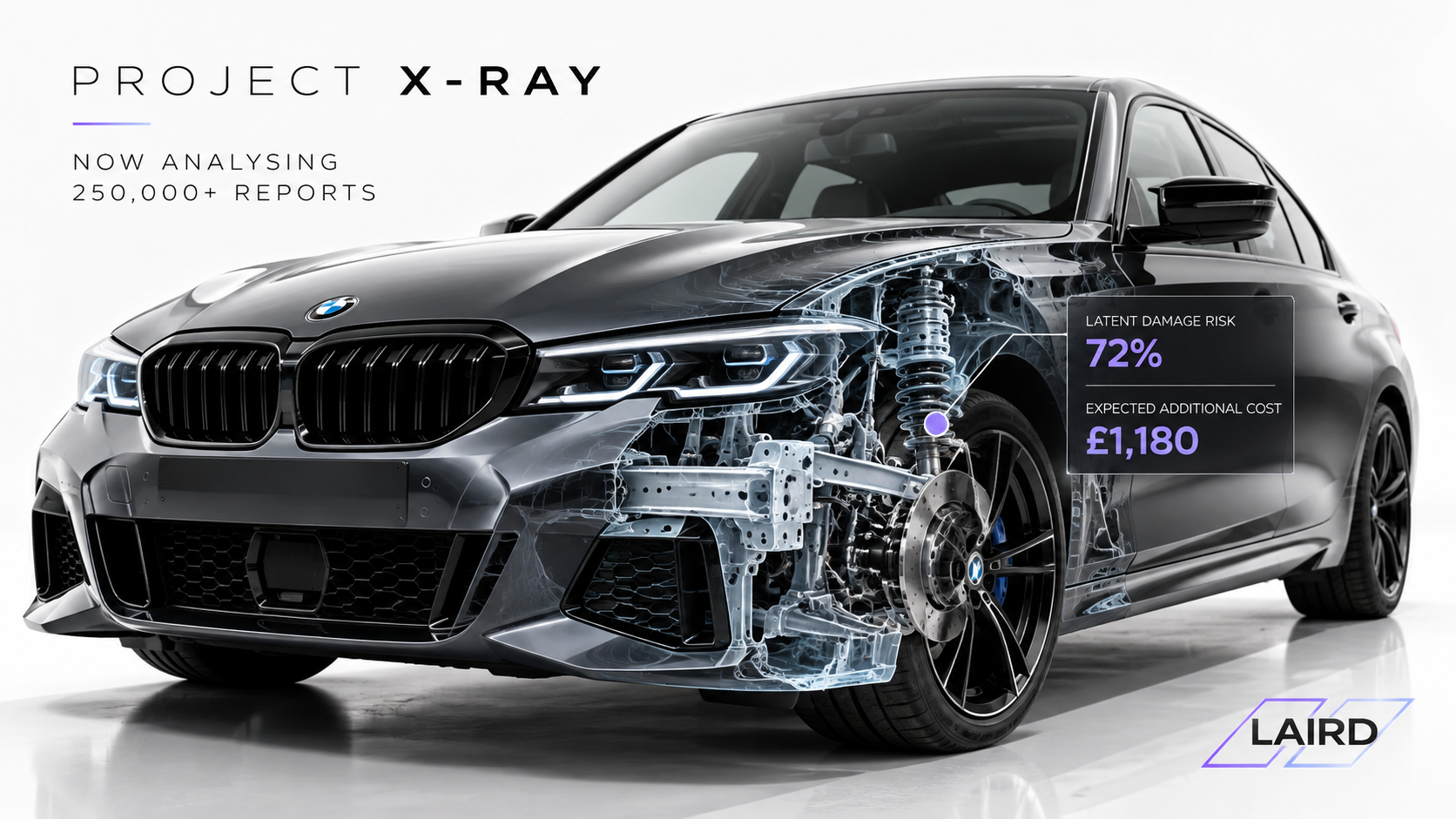
This is exactly why we built Project X-Ray to prevent as many of these costly amendments as possible.
Laird has years of historic accident-damage reports containing millions of lines of crash, parts, repair and cost data. Project X-Ray analyses that history to find comparable repairs and show our engineers the risk that the current estimate may not yet reflect. It can indicate the likelihood of further costs being uncovered, the range into which the final repair cost is likely to move and whether a supplementary estimate could push the vehicle towards, or beyond, the economic total-loss threshold.
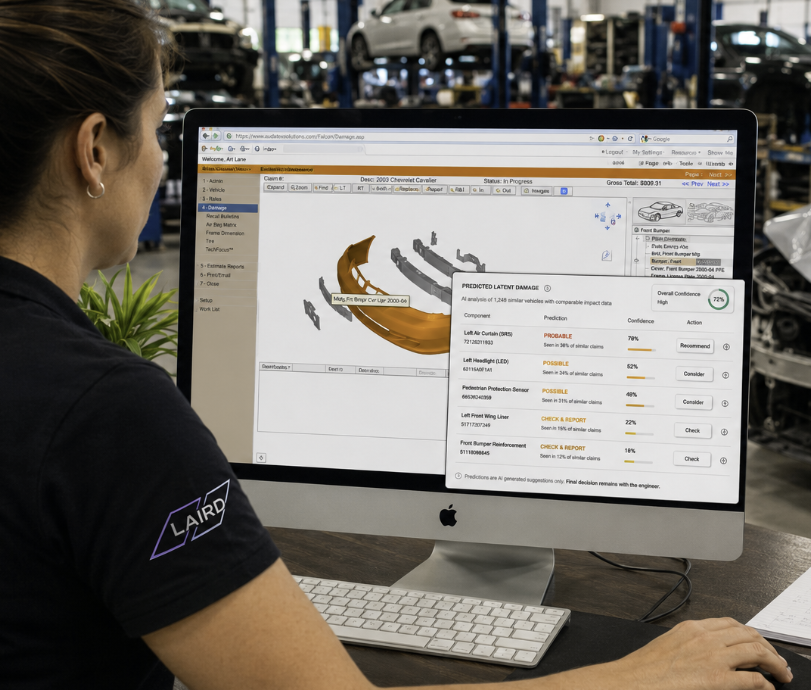
Where the available data is sufficiently detailed, Project X-Ray can go further and flag specific parts that were commonly added later on comparable repairs. It is not simply saying that a front impact may cost more than first thought. In the right cohort, it can prompt the engineer to check for a particular sensor, reinforcement or related component that is absent from the initial parts list.
That information is presented as evidence for the engineer, not as an automatic addition to the estimate. The system becomes more useful because it combines real repair outcomes with professional judgement. Our engineers can test the prediction against the images, accident circumstances, vehicle specification and relevant Thatcham or manufacturer repair data before reaching a view.
This also means Project X-Ray can work alongside visual intelligence enhancing rather than competing with it. Computer vision can identify what the camera can see. A detailed estimating platform can translate visible damage into an initial schedule of operations. Project X-Ray examines what happened on similar repairs and presents the financial and technical risk that may still be hidden. The engineer brings those sources together and remains accountable for the final assessment.
For Accident Management Companies, fleet operators and claims businesses, the commercial benefit is straightforward. Better information at the beginning of the claim supports more reliable repair decisions, more realistic reserves and earlier identification of borderline total losses. It can reduce avoidable supplementary administration, late parts orders, repair stop start interruptions and extended hire. It also gives clients a clearer and more defensible explanation of why a vehicle should be repaired, inspected further or treated as a total loss.
I have always believed that technology should help experienced people make better decisions. It should not reduce a complex accident-damage assessment to a rough matrix because that is quicker to produce. Project X-Ray is the result of combining Laird’s repair history, our engineers’ experience and modern predictive technology to address one of the most persistent sources of delay and cost in motor claims.
To the best of our knowledge, it is the first estimating support system to present the case-specific risk and likely cost of latent accident damage from historic crash and repair outcomes, with the ability in suitable cases to identify the parts most likely to be missing.
It is an exciting step forward, but its purpose is practical: to help our engineers and clients understand more of the repair before the bodyshop has to reveal it for them.