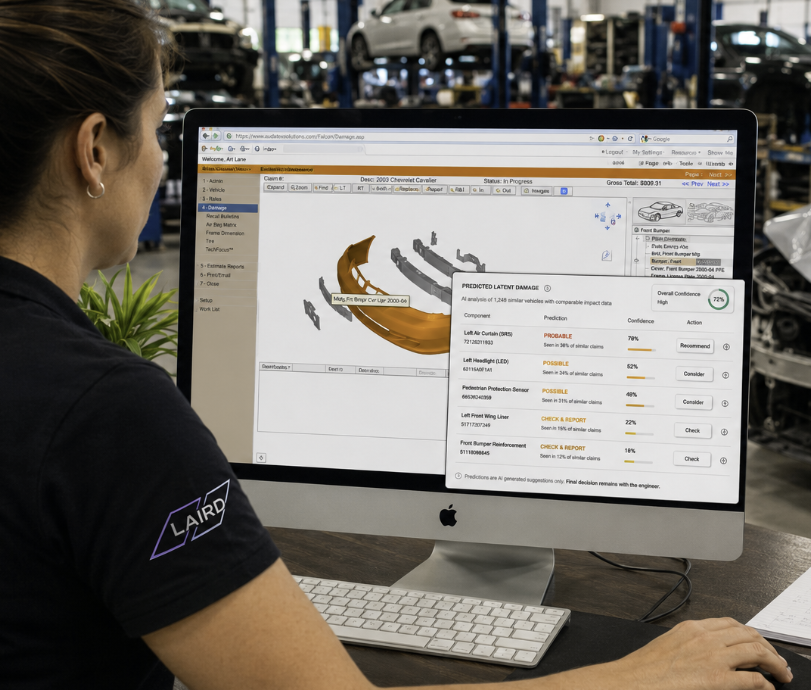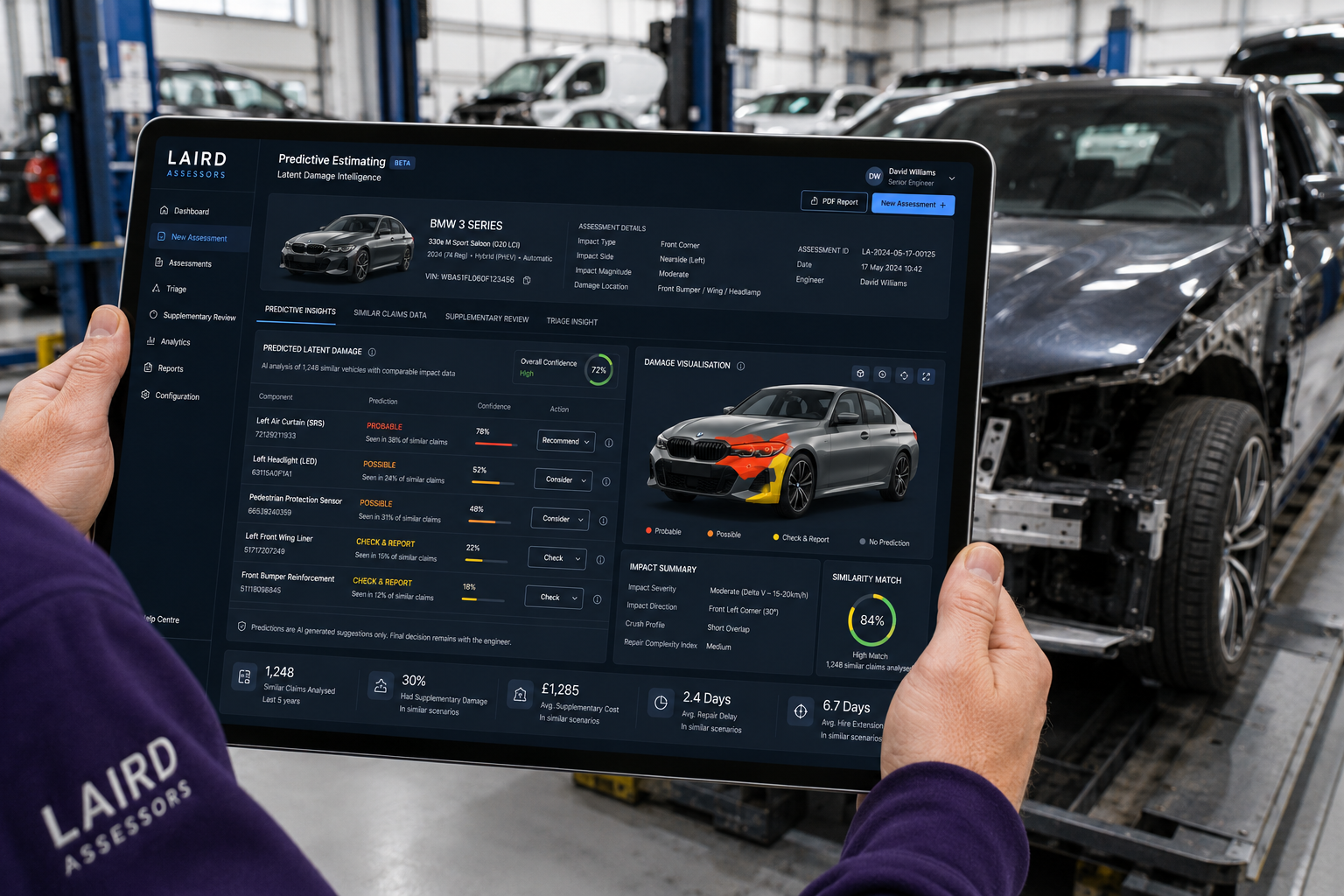
We're proud to announce a major breakthrough in vehicle damage estimating, with the development of a new AI-driven predictive estimating system designed to help identify hidden vehicle damage before strip down even begins.
Built using Large Language Model (LLM) technology and powered by Laird’s extensive real-world repair and engineering database, the system analyses patterns across hundreds or thousands of vehicle inspections, repair outcomes and supplementary requests to intelligently predict latent damage.
This represents a significant step forward for the UK motor claims industry.
Supplementary Damage
For decades, supplementary damage has been treated as an unavoidable part of the repair process. Hidden damage discovered after dismantling creates delays, increases hire costs, interrupts workshop flow and generates substantial additional administration across insurers, engineers, repairers and accident management providers. We believe that can now change.
Rather than relying on rigid vehicle-specific rules, the platform uses predictive grouping intelligence, analysing factors such as:
Vehicle make and model
Impact direction
Damage location
Severity of impact
Vehicle construction and material type
Euro NCAP characteristics
Historical repair outcomes
The system then compares the vehicle against similar historical cases to calculate the probability of latent damage existing behind the visible impact area.
For example, if hundreds of similar BMW 3 Series vehicles involved in comparable front-corner impacts historically required supplementary items once dismantled, the system will intelligently identify the likelihood of those same hidden components being damaged again.
Suggestions are categorised by confidence level:
Probable damage is recommended as a replacement part
Possible damage is recommended to be considered
Check and report recommendations suggest the items are examined once uncovered
Human in the Loop
Importantly, the AI does not make repair decisions or automatically add parts to estimates. The final engineering judgement always remains with the assessor. The platform is designed to augment engineering expertise, not replace it.
Because the intelligence is pattern-based rather than fixed to specific vehicles, the system can also recognise similarities across newly launched models and even badge-engineered vehicles that share common structures and repair characteristics.
Triage
The technology is also being integrated into Laird Assessors’ triage services, adding a new layer of latent damage intelligence beyond visual image analysis alone. In addition, the system can assist engineers when reviewing supplementary requests from repairers by indicating the probability of requested items being reasonably associated with the reported impact.
The result is a smarter, more predictive approach to vehicle damage assessment that aims to:
Reduce supplementaries
Improve first-estimate accuracy
Shorten repair times
Reduce unnecessary administration
Improve repair continuity
Reduce hire duration exposure
Deliver better customer outcomes
This innovation reinforces Laird Assessors’ commitment to combining independent engineering expertise with advanced technology to improve efficiency, accuracy and transparency throughout the motor claims process.
The future of vehicle damage assessment is no longer reactive. It’s predictive.