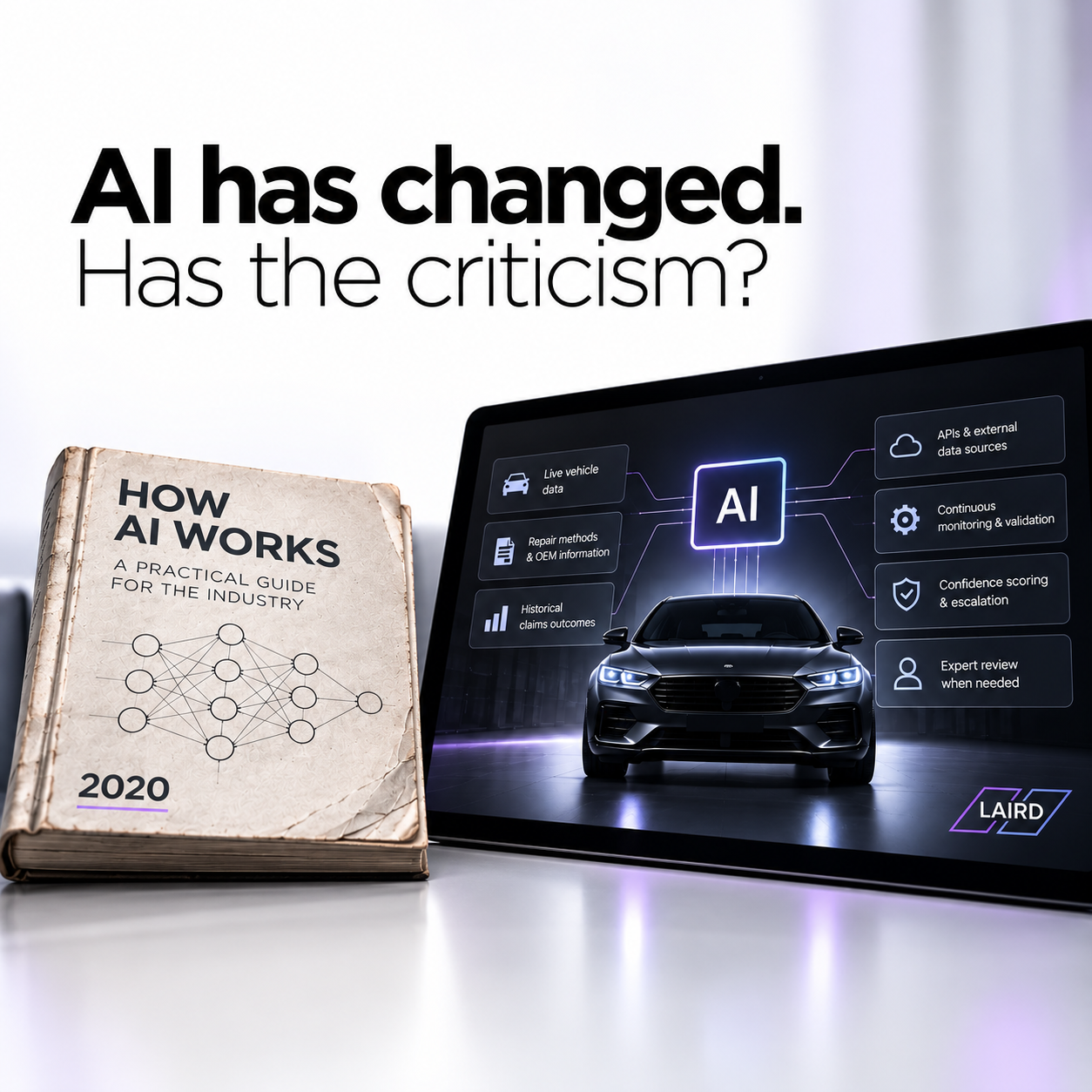
There’s a growing conversation around AI in vehicle damage assessing, particularly in estimating and damage evaluation. Most of it focuses on what the technology can do, how quickly it can produce outputs, how much time it can save, and how it might change the role of the engineer.
From a practical standpoint, the more important question is not what AI can do, but how it is actually used within a real operational environment.
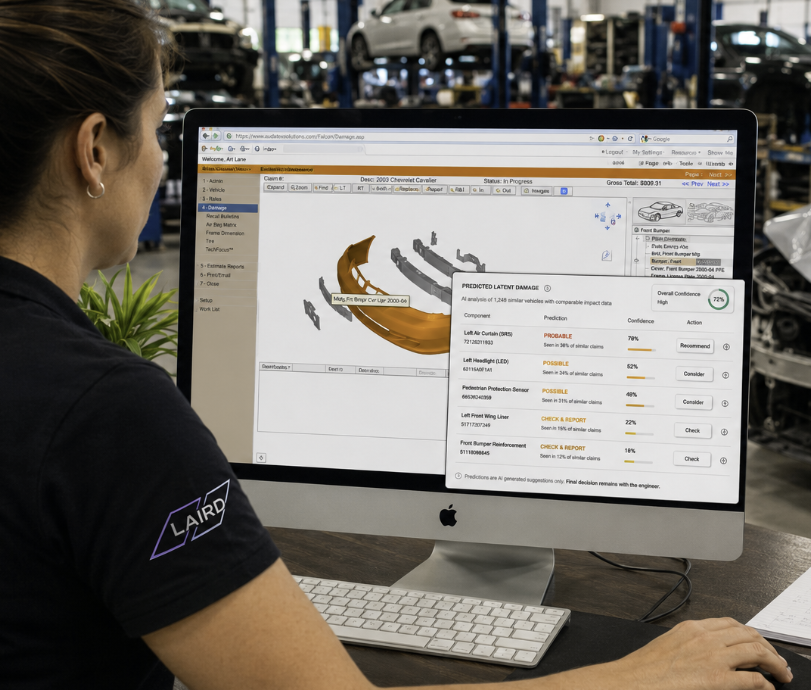
At Laird, the approach has never been about replacing engineers or automating decisions. It has been about redesigning the workflow so that technology stack, including Audatex, Glass's, Percayso, MotorSpecs & others, support the process properly, and engineers are positioned where they add the most value.
Moving beyond traditional estimating models
In a traditional setup, a significant portion of an engineer’s time is spent building an assessment from the ground up. That includes reviewing images, interpreting damage, constructing estimates, writing reports, and managing updates across multiple systems.
While these tasks are necessary, they are not where the highest level of engineering judgement is applied. They are process-heavy, repeatable, and often time-consuming.
What we have done at Laird is remove much of that friction by embedding AI and automation directly into the workflow. Instead of starting with a blank page, engineers are working from structured, system-generated outputs that have already processed the initial inputs.
This fundamentally changes how the role operates.
Repositioning the engineer
The role of the motor engineer becomes more focused; rather than spending time assembling information, the focus shifts to reviewing, validating, and making informed decisions. This includes applying commercial judgement, understanding repair viability, identifying inconsistencies, and ensuring that each outcome is appropriate for the specific case.
AI can assist with speed and structure, but it does not carry accountability, and it does not understand context in the way an experienced engineer does. That remains firmly with the person.
At Laird, every assessment is still owned by an engineer. The difference is that the engineer is no longer constrained by the administrative weight of the process.
Why implementation is where most approaches fall short
Many solutions in the market focus on introducing AI as an additional layer, something that sits alongside existing systems and processes. In practice, this often leads to limited impact, because the underlying workflow remains unchanged.
The real gains come from redesigning the operation itself.
At Laird, AI, automation, and workflow management are not separate components. They are part of a single, integrated system, Swiftcase. This allows work to move consistently from input through to outcome, with minimal manual intervention where it is not required.
As a result, the engineer interacts with a system that is already structured, rather than one that needs to be built manually each time.
Consistency, scalability, and control
One of the long-standing challenges in assessing has been achieving consistency across different engineers and cases. Variations in interpretation are natural, but they can lead to inefficiencies and rework.
By introducing a consistent starting point through AI and structured workflows, we are able to reduce that variability while still allowing for professional judgement.
This has a direct impact on scalability. Growth is no longer dependent on increasing headcount at the same rate as workload. Instead, the system absorbs much of the process, allowing engineers to focus on decisions and manage a higher volume of work without compromising quality.
Importantly, control is not lost in this model. It is strengthened. Every decision is still reviewed and signed off by a qualified engineer, supported by better information and more consistent inputs.
A more realistic model for AI in assessing
The most effective model is not full automation, and it is not manual-first supported by occasional tools. It sits somewhere in between.
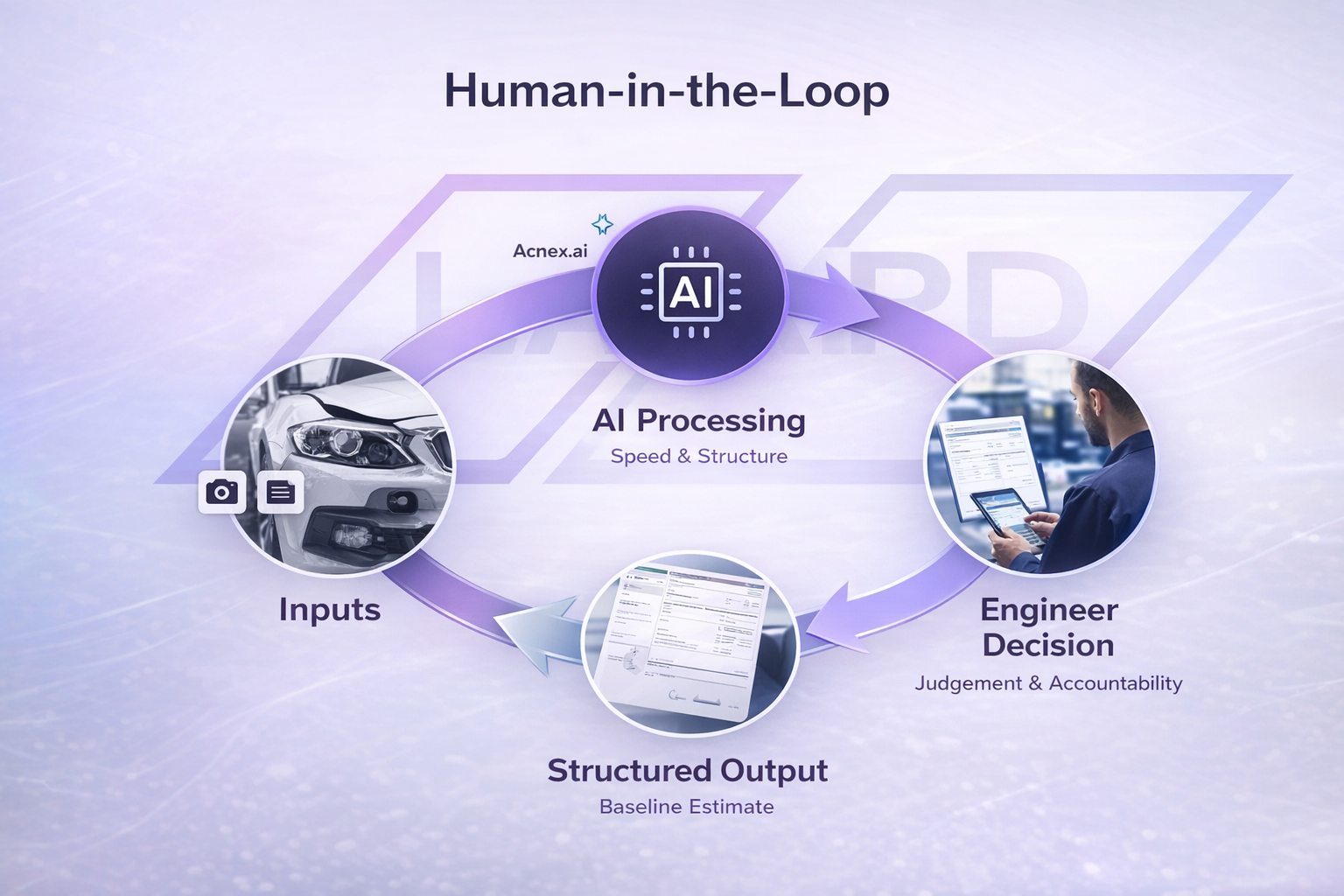
AI provides the initial structure and processing. Automation manages the flow of work. The engineer applies judgement and takes ownership of the outcome.
This human-in-the-loop approach ensures that quality, accountability, and professional standards are maintained, while still delivering the efficiency gains that modern systems can provide.
Where this leaves the industry
AI in assessing is no longer theoretical. The technology is available, and its capabilities are well understood.
The difference now lies in execution. Businesses that treat AI as an add-on are likely to see incremental improvements at best. Those that redesign their workflows around it will see a far more meaningful shift in how they operate.
At Laird, the focus has been on the latter. Not simply introducing AI, but building a model where it is part of the core process, supporting engineers rather than replacing them.
From an engineering perspective, the objective is straightforward. Reduce the time spent on process. Increase the time spent on decisions. Maintain accountability throughout.
Technology enables that, but only when it is implemented in the right way. That is where the real difference lies.