We've seen the odd misconceptions, mainly from old-school non-technical corners, that if an engineering business uses AI, the AI must somehow be making the engineering decisions. That simply isn't how professional AI systems are deployed, nor is it how we use them at Laird.
Over the last three years we have invested heavily in AI, workflow automation and software engineering, primarily through Swiftcase. Our objective was not to automate engineering judgement, but the vast amount of administrative overhead that surrounds it. Engineering opinion and administrative process are fundamentally different disciplines.
AI Is an Ecosystem, Not a Chatbot
When people hear the term AI, they often think of ChatGPT or another large language model. In reality, modern AI systems are made up of multiple technologies working together.
At Laird, large language models (LLMs) represent only one component. Alongside them sit natural language processing (NLP) pipelines, computer vision models, optical character recognition (OCR), machine learning algorithms, vector search, semantic indexing, rule-based automation engines, API orchestration and deterministic business logic. Each technology performs a specific function and each has defined boundaries.
Incoming emails are classified automatically, attachments identified, metadata extracted and relevant documents associated with the correct case. OCR converts unstructured documents into searchable structured data. NLP identifies entities such as registration numbers, VINs, repairers, insurers, claim references and locations. Semantic search retrieves relevant historical cases, repair methodologies or technical bulletins within seconds rather than relying on keyword searches.
Large language models then assist with administrative tasks such as summarising lengthy correspondence, producing draft documentation, extracting salient facts from multiple sources and presenting information in a format that is easier for an engineer to review. Every output remains editable and reviewable.
Automation Removes Administration
Much of what traditionally occupied administrative teams is now performed automatically.
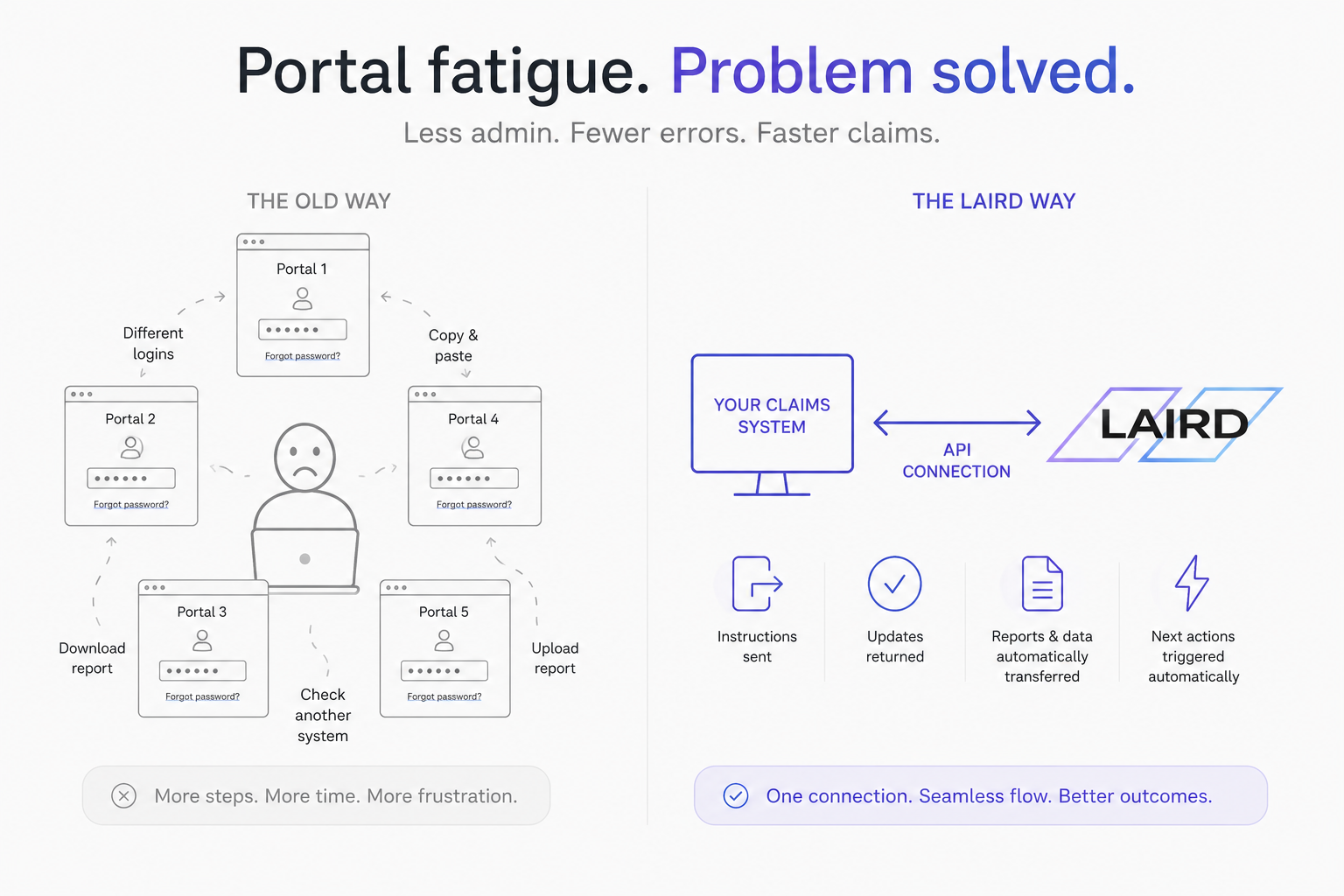
Systems request missing documentation, monitor inboxes, validate incoming data, synchronise multiple software platforms such as Glass's, Audatex, Percayso, Motor Checks, DVLA, HPI, GT Motive, supplier & client systems, etc. It's also used to schedule inspections, notify customers, our customer's clients, hire car teams, chase outstanding information, generate workflow tasks and prepare report templates without human intervention.
These processes are driven by workflow engines and business rules rather than engineering judgement. They execute predefined logic consistently and eliminate repetitive manual handling that historically consumed significant engineering and administrative time.
The result is fewer transcription errors, faster turnaround times and significantly greater operational consistency.
Machine Learning Supports Engineering
Beyond administration, we also apply machine learning to engineering support.
Historical repair outcomes, vehicle architecture, repair methods, OEM procedures, parts replacement trends and supplement frequency can all be analysed to identify patterns that may indicate latent damage. Rather than simply recognising images, models learn statistical relationships between damage characteristics and historical repair outcomes, reducing supplementary requests.
For example, particular impact locations on specific vehicle platforms may historically correlate with damaged ADAS sensors, wiring harnesses, structural components or battery protection systems. Those relationships can be surfaced automatically so they are brought to the engineer's attention for investigation.
This is precisely how our Project X-Ray predictive estimating technology operates. It highlights engineering probabilities based on thousands of historic repair decisions. It does not determine that hidden damage exists, it identifies where an experienced engineer should look more closely, and that distinction matters.
The Engineer Remains the Decision Maker
None of these technologies determine liability, causation, repair methodology or repairability.
None decide whether damage is consistent with the reported circumstances.
None determine whether OEM procedures have been followed.
None decide whether repairs are technically safe or economically appropriate.
Every engineering conclusion remains the responsibility of the qualified engineer.
The Human in the Loop reviews the evidence, interrogates AI-generated outputs, rejects incorrect assumptions, considers manufacturer guidance, structural loading paths, material characteristics, ADAS calibration requirements, EV safety considerations and repair economics before reaching an independent professional opinion.
The report is amended where necessary, approved and signed by that engineer, who accepts full professional responsibility for every conclusion.
CPR Compliance Has Never Been About Who Typed the Report
There is sometimes an assumption that AI somehow creates a conflict with CPR compliant reporting.
That misunderstands where expert evidence derives its authority.
The authority comes from the expert's independent opinion, not from who typed the words, formatted the document or collated the evidence. Engineers have always relied upon support mechanisms, whether secretaries, administrative assistants, estimating systems, technical databases or repair methodologies. AI simply performs many of those administrative functions faster, more accurately and with far greater traceability.
The expert remains under the same professional obligation to exercise independent judgement and can never delegate that responsibility to software.
Better Auditability, Better Governance
Ironically, AI often strengthens governance rather than weakening it.
Every workflow stage in Swiftcase, prompt, system action, API transaction, document revision, approval and human intervention can be timestamped and audited. Version histories can demonstrate precisely how information evolved throughout the lifecycle of a case. Data lineage can identify where every fact originated, whether from an insurer feed, repair estimate, engineering inspection, image analysis or manual input.
That level of transparency is considerably stronger than many traditional manual processes.
Technology Should Elevate Expertise
Modern vehicles are becoming significantly more complex. ADAS, radar, lidar, camera systems, high-voltage EV platforms, mixed-material construction, bonded structures and increasingly sophisticated electronics demand higher levels of engineering competence than ever before.
The industry needs engineers spending more time applying technical expertise and less time copying data between systems, drafting repetitive correspondence or managing administrative workflows.
That has always been our objective.
We invest heavily in AI because we believe technology should amplify engineering capability, not replace it. Administrative work is increasingly becoming a software problem. Professional judgement remains, and should remain, entirely human.