A Profession at a Crossroads
For much of my career, the path to becoming a competent vehicle damage assessor was relatively clear. Learn vehicle construction, understand repair methods, become proficient with estimating systems, get qualified, understand how bodyshops work and gain enough experience to make sound technical decisions. Those foundations remain important today but assessing has changed incredibly.
The vehicles we assess bear little resemblance to those of twenty years ago. Advanced ADAS systems, complex electronics, connected vehicle technologies, new materials, electric drivetrains and increasingly sophisticated repair methodologies have fundamentally changed the technical landscape. At the same time, customer expectations have risen dramatically, claims processes have evolved and technology has transformed the way information is gathered, analysed and shared.
Yet in some corners of the industry, training still feels rooted in a world that no longer exists, which is not a criticism of the past, after all the standards, qualifications and training pathways that helped shape our profession played an important role in raising competence and professionalism. They were entirely appropriate for their time. Problem is that our industry has not stood still, so neither should we.
Technology Has Changed the Question
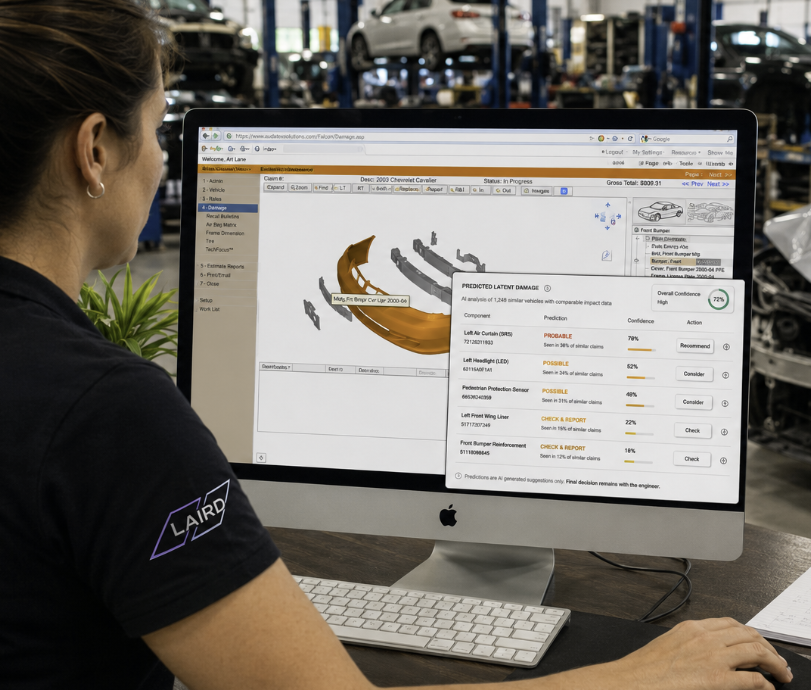
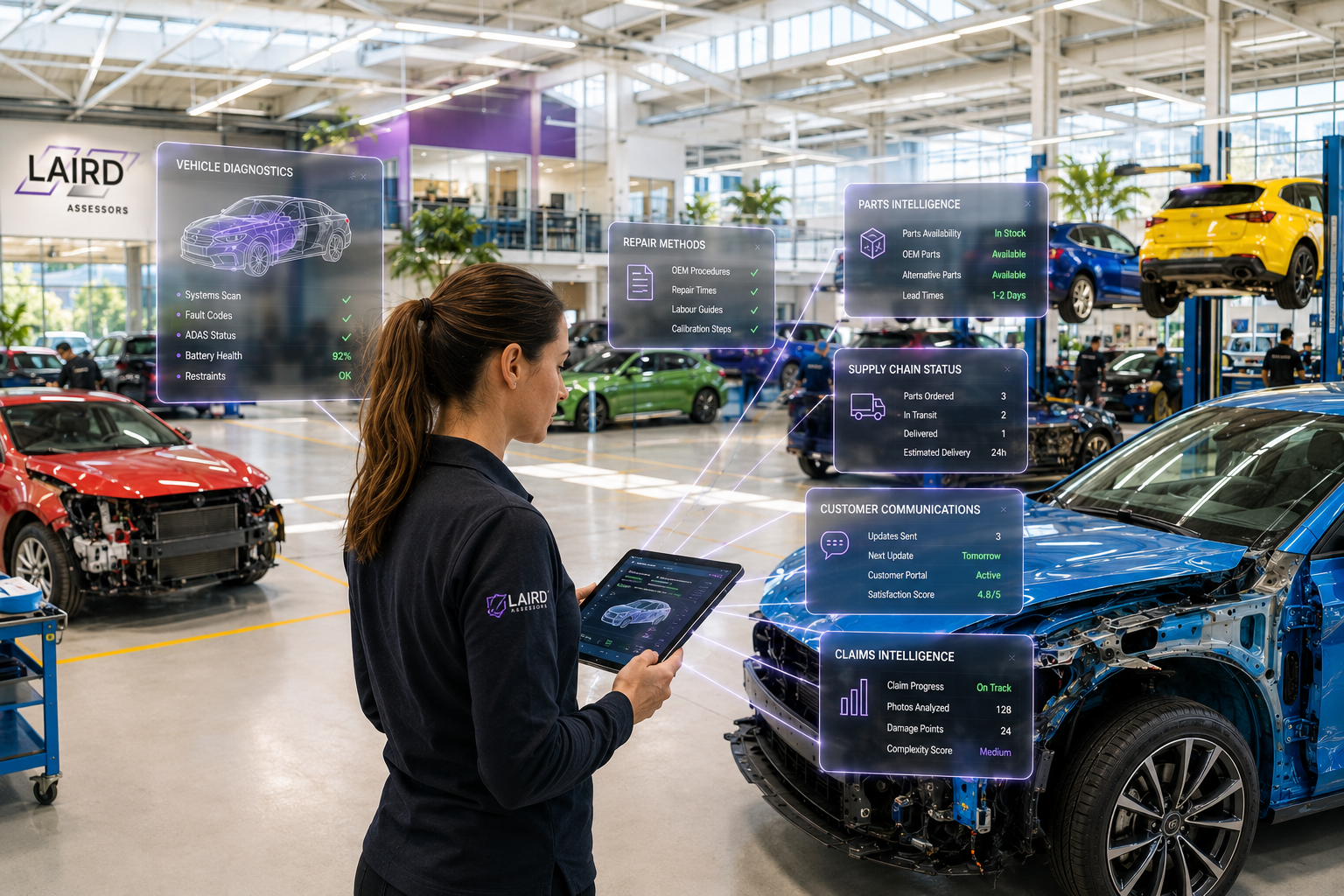
Much of the current discussion around artificial intelligence centres on whether it will replace assessors. In my view, that debate misses the point entirely. The real opportunity is that AI is becoming increasingly capable of gathering information, analysing images, retrieving technical data, identifying repair procedures, coordinating workflows and automating routine administrative tasks. Activities that once consumed a significant portion of an engineer's day can now be completed in a fraction of the time. That excites us at Laird!
If technology can handle much of the administration surrounding an assessment, it creates a far more interesting question: What should the engineer be doing with the time that creates? The answer, surely, is more engineering.
The Difference Between Information and Judgement
There has always been a tendency within our profession to associate value with the production of reports, estimates and documentation. Those outputs are important, but they have never been where the real value lies. Insurers, Accident Management & solicitors do not engage assessors because they want a report, but because they need informed decisions; total loss or repairable, injuries likely or not, roadworthy or not...
They need somebody who understands vehicle construction, repairability, safety implications, repair economics, emerging technologies and commercial realities. They need somebody capable of balancing technical considerations against customer outcomes and business objectives.
In short, they need engineering judgement. Tech can gather information faster than ever before. It can organise it, present it and with Swiftcase analyse it.
What it cannot do is replace decades of engineering experience, professional judgement and contextual understanding. The future assessor is therefore becoming more focused on the aspects of the role that genuinely matter.
From Administrator to Engineer
For years, a significant proportion of an assessor's working day has been consumed by activities that, while necessary, are not fundamentally engineering tasks. Searching for information, gathering supporting evidence. producing documentation, updating stakeholders, managing workflows, re-keying data between systems. Technology is increasingly capable of supporting or automating many of these activities.
That allows engineers to spend more time evaluating repair methods, understanding structural implications, considering zone 99, specialist & ADAS requirements, assessing repair versus total loss decisions and helping clients achieve better outcomes.
In many respects, the profession is moving away from administration and back towards engineering, and we welcome that.
Why Training Must Change
If the role is evolving, training must evolve with it. Historically, assessor development has understandably focused on producing assessments accurately and consistently. Those skills remain essential, but they are no longer sufficient on their own.
Tomorrow's engineers need a broader skillset. They need to understand advanced vehicle technologies, emerging repair methodologies, calibration requirements, evolving construction techniques and increasingly complex manufacturer procedures.
They also need to understand data, automation and artificial intelligence, because these tools have rapidly become part of everyday engineering practice.
Most importantly, they need to develop the ability to think critically. As technology becomes more capable, the value of human judgement increases, not decreases.
Future assessors must be able to challenge information, recognise anomalies, understand context and make decisions where there is no obvious answer. Those are engineering skills and they deserve far greater emphasis than they often receive today.
What We've Changed at Laird
At Laird, we recognised several years ago that the profession was changing faster than many traditional training models could accommodate.
Rather than waiting for training standards to catch up, we decided to evolve our own approach & set up our Engineering Academy.
Our training now places significantly greater emphasis on engineering judgement, technological literacy, client understanding, critical thinking and continuous learning. Engineers are taught not only how to assess damage, but how to understand the wider environment in which those assessments are made.
We actively incorporate emerging technologies into our development programmes because our engineers will encounter these tools every day throughout their careers. Ignoring them would be doing our people a disservice.
Equally, we place considerable focus on contemporary vehicle technologies and repair methods. The pace of change across the automotive sector is extraordinary and there is little value in training engineers for the vehicles of yesterday when they are expected to make decisions about the vehicles of tomorrow.
Perhaps most importantly, we encourage curiosity. The best engineers are those who continually seek better ones. If that means dragging parts of assessor training, kicking and screaming, into the modern era, then so be it. Our responsibility is not to preserve historical or out-dated approaches for the sake of tradition.
Our responsibility is to prepare engineers for the realities of the profession as it exists today and as it will exist tomorrow.
The Opportunity Ahead
I believe the challenge is ensuring that our thinking, our training and our professional development evolve at the same pace as the vehicles we assess and the technologies we use.
The profession is becoming more technical and more demanding.
The engineers who thrive over the next decade will be those who combine strong technical foundations with technological awareness, commercial understanding, adaptability and sound judgement.
Technology will handle more of the heavy lifting, and that is an opportunity to spend more time applying the expertise that only engineers can provide.
The future belongs to those who embrace that opportunity. We may be preparing too many assessors for a profession that no longer exists. As technology takes over routine administration, the future belongs to engineers who can apply judgement, adapt continuously and thrive in a rapidly changing industry.The question is whether we are prepared to train for it.