Visual intelligence (VI) and multimodal LLMs are fairly good at looking at cars & there's plenty of them on the market today. Give most of them a decent set of photographs and they can spot scratches, dents, scuffed wheels, cracked lamps and obvious panel damage with impressive consistency. For de-fleeting, off-hire inspections and general vehicle condition reporting, it's genuinely useful technology.
For accident damage estimating, however, they are nowhere near good enough.
The problem is fairly obvious to anyone who has spent years assessing damaged vehicles: cameras see surfaces. Accident damage does not politely stop at the surface.
A model may correctly identify a damaged bumper, wing and headlamp, then produce an estimate that looks polished, structured and reassuringly confident. Unfortunately, the confidence is often doing more work than the engineering.
The expensive damage is frequently behind what the camera can see.
An experienced engineer is not simply identifying broken parts. We are reading the impact. We are looking at magnitude of the impact, the deformation & it's direction, component relationships (often latent), adjacent structures, likely displacement and what historically tends to fail when a particular area of a particular vehicle is hit in a particular way.
That is where current visual intelligence starts to run out of road.
A camera can tell you the wing is dented. It cannot reliably tell you what has happened behind the wing.
An LLM can list the components that look damage based on its data base, but knowing a latent component even exists is very different from knowing whether it is likely to have been damaged in this collision.
The problem with impressive-looking AI estimates
One of the more dangerous characteristics of modern AI is how convincing it can look when it is wrong.
A poor human estimate often looks poor. A poor AI estimate can arrive neatly formatted, itemised and written with absolute confidence. To somebody without engineering experience, it can look authoritative. That makes it potentially more dangerous, not less.
We have tested enough of these systems at Laird to know the pattern. They are generally strong on obvious external damage and increasingly competent at identifying vehicle make, model, panel location and visible severity. Then they start estimating the hidden damage, and things become much more speculative.
That might be acceptable if the output were clearly labelled as uncertain. The difficulty is that AI does not naturally look embarrassed when it has missed half the car.
In an accident repair environment, omissions have consequences, often serious. They create supplementaries, delays, additional authorisations, extended hire, parts disruption and repeated communication between repairer, insurer, engineer and customer.
Occasionally, the missed item is much more significant than an administrative nuisance. Modern vehicles have ADAS hardware, pedestrian protection systems, sensors, radars, cameras, active bonnet equipment, brackets and structural components hidden behind relatively ordinary-looking panels.
Missing those because they were not visible in the first photograph is not particularly clever automation.
Take this MINI
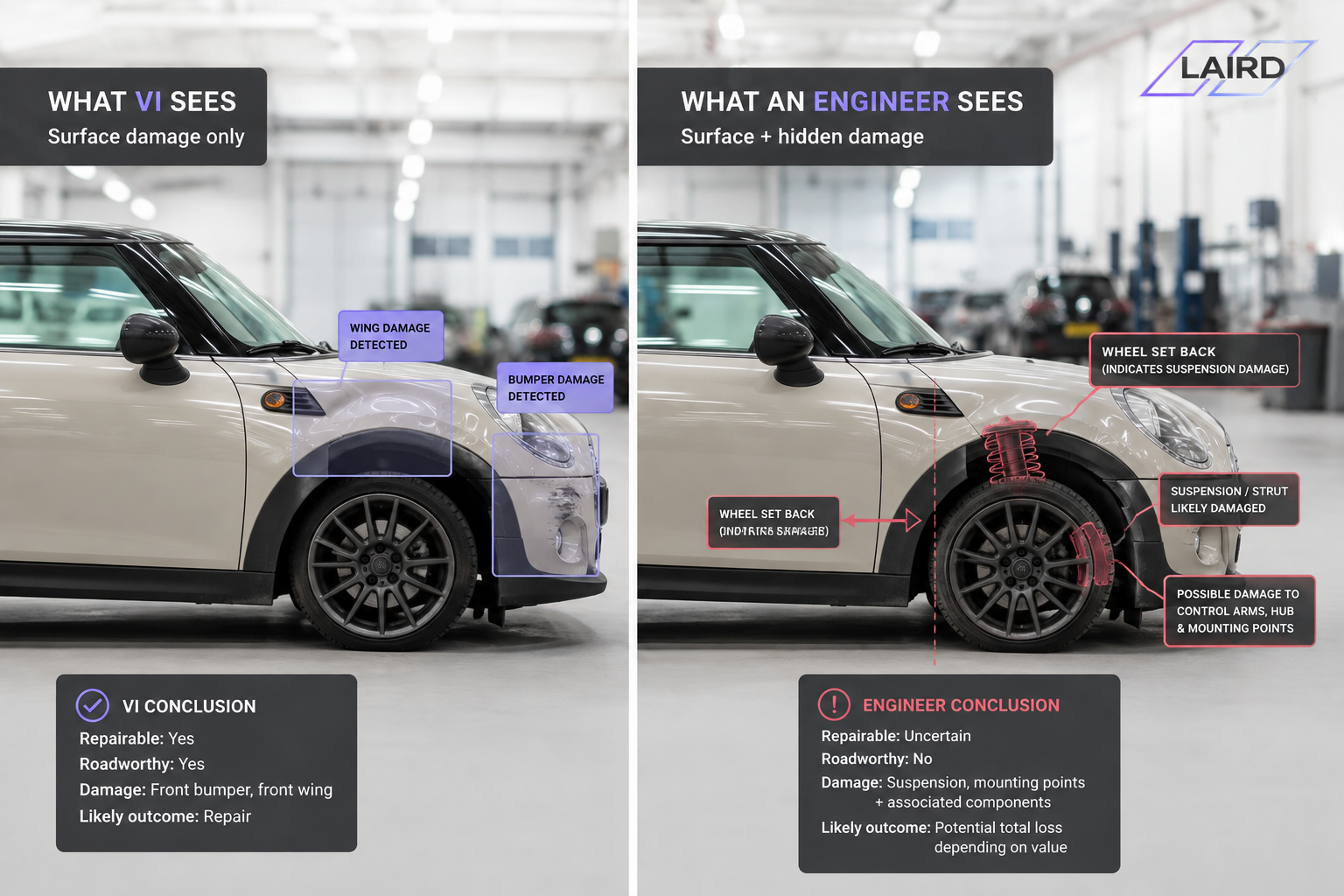
Take the MINI shown here. The visual intelligence has correctly identified the damage to the bumper, front wing and wheel arch. On a superficial read, that is a perfectly reasonable result. Based on those visible items alone, the system could quite easily conclude that the car is repairable and, more worryingly, still roadworthy.
Look a little closer and the picture changes.
The front wheel is sitting noticeably further back in the wheel arch than it should. That is a classic clue that the impact has affected the suspension or associated mounting points, even though there is no dramatic visible damage to the outside of the wheel or tyre itself.
An experienced engineer will pick that up very quickly because the wheel position is part of the damage pattern, not just part of the photograph.
The implications are significant. A car with probable suspension damage is certainly not something we would be describing as roadworthy, and once the underlying damage is stripped and measured, the economics of the repair may change completely. Depending on the value of the vehicle, what initially looked like a straightforward wing and bumper repair could ultimately become a total loss.
That is exactly where VI-only estimating becomes dangerous: it can be technically correct about everything it has identified, yet still reach the wrong overall conclusion because it has missed the clue that actually matters most.
If it worked, we would already be using it
Laird is hardly technology-shy.
We have invested heavily in AI, automation and data-led engineering, and we have been testing these technologies long before AI became the latest item on every boardroom agenda.
If commercially available visual intelligence or LLM-based estimating could reliably assess accident damage, we would be using it now.
It would be faster, cheaper and highly scalable. There would be absolutely no prize for stubbornly keeping humans in a process that software could perform better.
The problem is that, at present, it cannot.
There is a big difference between technology that looks impressive in a demonstration and technology you are prepared to trust on thousands of real claims where somebody ultimately has to pay for the mistakes.
The current systems are simply too dependent on what is visible, too weak on latent damage and too inconsistent in their reasoning around secondary and consequential damage. For vehicle condition work, that may be perfectly acceptable. For accident engineering, it is not.
Experienced engineers already perform a form of predictive analysis
A good engineer develops an instinct for hidden damage because they have seen the same relationships repeatedly.
They know that if a certain component has moved, something behind it may also have moved. They know which brackets break without leaving obvious external evidence. They know where energy tends to travel through a structure and which parts are routinely discovered during strip-down after initially appearing unaffected.
This is simply pattern recognition built from experience. In machine-learning terms, an experienced engineer has spent years training on an extremely messy dataset. The difference is that the engineer has also seen the ground truth.
They have inspected the vehicle before strip, seen what appeared damaged, then seen what was actually found once the repair began. That feedback loop is enormously valuable. Most current visual estimating systems do not have enough of it. They are trying to infer internal damage primarily from external pixels. That is a difficult problem however large the neural network happens to be.
That is why we developed Project X-Ray
Project X-Ray takes a different approach; rather than expecting a vision model to somehow develop literal X-ray vision, we use historical engineering and repair data to help predict what may be damaged beyond the visible surface.
The principle is straightforward. If a particular type of impact on a particular vehicle repeatedly results in certain hidden components being damaged, that relationship can be learned. If we know that component A is visibly damaged and historical claims show that component B is subsequently found damaged in a meaningful percentage of similar cases, that is useful engineering intelligence.
Project X-Ray can bring those relationships to the engineer's attention while the assessment is being completed.
The system can identify components that are probably damaged, possibly damaged or should be checked during strip-down, based on what has happened in comparable repairs.
That gives us something fundamentally more useful than a visual model saying, in effect, "I can see a broken bumper." We already know the bumper is broken. We want to know what else we should be looking for.
Hidden damage is where the real value sits
Consider components positioned behind exterior panels. On some vehicles, pedestrian protection equipment, sensors or mounting structures can sit in areas where fairly modest-looking external damage may have consequences that are invisible in photographs.
An experienced engineer will often recognise that possibility immediately because they understand the vehicle and have encountered similar repairs before. A generic AI model may know the component exists. It may even confidently mention it if prompted correctly.
Project X-Ray goes further by asking a much more useful question: how often was that component actually damaged when we previously saw this pattern of impact?
That is the difference between theoretical knowledge and engineering evidence. The more claims and repair outcomes we analyse, the stronger those relationships become.
AI should expand engineering judgement
The most useful role for AI in vehicle damage assessment is not replacing the engineer's judgement. It is dramatically increasing the amount of evidence available to that engineer. No individual engineer can personally inspect every version of every vehicle involved in every type of accident.
A data-driven system can effectively pool the experience contained across a very large number of previous assessments and repairs. That means an engineer assessing one damaged vehicle can benefit from what happened across thousands of comparable vehicles before it.
The technology becomes an additional layer of engineering intelligence. It can say, in practical terms: similar vehicles with similar visible damage frequently had these additional components damaged once stripped, so check them.
An AI confidently drawing boxes around a crushed bumper and announcing that the bumper is crushed is slightly less revolutionary.
Where this goes next
Visual intelligence will improve. Multimodal models will improve. Vehicle data will improve, and the systems will undoubtedly become much better at reasoning across photographs, repair information and technical specifications. We are actively watching that development and incorporating the useful parts into our own work, but accident damage assessment needs more than image recognition.
It needs vehicle-specific knowledge, probabilistic reasoning, repair history, latent damage modelling and, critically, feedback from what was actually found during the repair.
That is the direction we are taking with Project X-Ray.
The eventual goal is straightforward: give the engineer the visible evidence, the vehicle data and the accumulated experience of thousands of previous repairs at the point they are making the decision.
Visual AI can tell us what it sees. Project X-Ray continues to be developed to help us understand what it cannot.