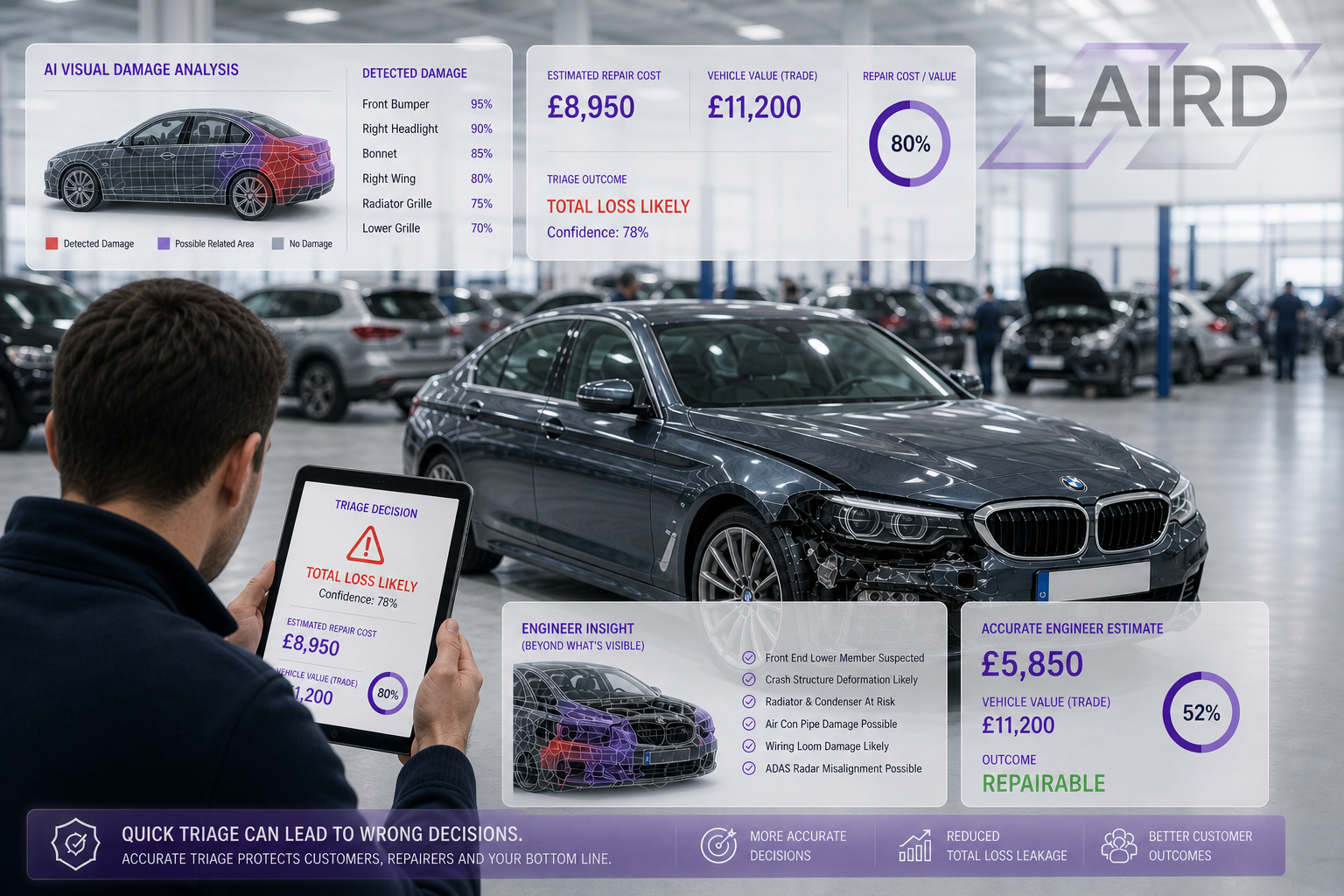
In today’s insurance landscape, speed is everything. Customers expect instant decisions, insurers demand efficiency, and technology promises both. At the centre of this shift sits image-based triage, a process designed to assess vehicle damage from photos and quickly determine whether a car should be repaired or written off.
On the surface, it appears sophisticated. In reality, it is, at best, a proxy — a structured guesstimate built on incomplete information. And when that estimate is wrong, the consequences are significant.
A Decision Made Too Early
Image triage attempts to answer a complex question using limited inputs:
Can this vehicle be safely and economically repaired?
But instead of a full inspection, strip-down, or engineering review, the decision is often based on a series of 2D images. No matter how advanced the system, it is still interpreting depth, structure, and mechanical integrity from flat visuals.
This introduces an unavoidable gap between what is seen and what is actually there.
The Proliferation of Triage — and Its Limits
There is no shortage of image-based triage solutions in the market today. Many can quickly identify obvious external damage, such as panels, lights, and bumpers, as well as visible deformation.
On the surface, this creates confidence. Damage is detected, panels are listed, and a cost is implied.
However, these systems are typically limited to what is immediately visible. They rarely identify latent or underlying issues that would be apparent to one of our qualified engineers, such as structural stress, hidden deformation, or component-level risks related to the impact.
In addition, the cost outputs produced at this stage are often not truly integrated with estimating systems. Instead, they rely on generalised assumptions; rule-of-thumb calculations based on panel type, severity, and average labour factors.
This results in a form of standardisation that does not reflect real-world variability: differences in manufacturer repair methods, material-specific repair vs replace rules, vehicle-specific complexity, labour rate and network variation.
In effect, many triage systems apply a one-size-fits-all model to what is, in reality, a highly specific and technical assessment process.
The outcome may appear structured, but it is often built on broad assumptions rather than precise, vehicle-specific accuracy.
What the Camera Cannot See
Modern triage systems are effective at identifying visible damage — panels, lights, bumpers, and obvious deformation. However, critical elements frequently sit beyond the reach of a photograph: structural distortion behind outer panels, subframe or suspension displacement, ADAS components requiring calibration or replacement, internal cracking, stress fractures, or alignment issues. The list goes on.
These are not edge cases. They are common in everyday collisions.
A bumper may look intact, while the crash bar behind it is compromised. A panel may appear repairable, while manufacturer guidelines require replacement. Sensors and systems embedded within the vehicle may be entirely invisible to the lens. The result is not just uncertainty, but systemic misjudgement.
The Cost of Getting It Wrong
Case Study 1: The Avoidable Total Loss
A 3 series BMW saloon, approximately five years old, presented with front-corner damage — bumper, headlight, and wing visibly affected. Image triage classified multiple panels as high severity and recommended replacement across the board.
The projected repair cost exceeded the insurer’s threshold, and the vehicle was categorised as a total loss.
However, upon later review by an actual human, one of our qualified engineers, it became clear that: the headlight mounting points were intact, the wing was repairable, and no structural deformation existed behind the bumper. A revised estimate reduced the repair cost significantly below the total loss threshold.
The vehicle could have been safely repaired. Instead, it was unnecessarily written off; a direct result of conservative, panel-driven estimation.
Case Study 2: The Repair That Should Never Have Started
A Tesla Model Y with seemingly moderate rear impact damage was triaged as repairable based on surface-level imagery.
Visible damage included: rear bumper distortion, boot lid misalignment
No immediate structural concerns were flagged.
Once in the bodyshop and stripped, the reality changed: Rear chassis leg kinked, the floor pan distortion discovered, ADAS recalibration requirements introduced
Repair costs escalated beyond the vehicle’s value. The claim transitioned to a total loss but only after: the bodyshop has started repairs based on the insurer's triage; labour had already been committed, parts had been ordered & repair time had been lost
This scenario is not uncommon. It highlights the risk of approving repairs based on incomplete information.
The Cost of Getting It Wrong Continues
When Repairable Vehicles Are Written Off
One of the most concerning outcomes is the unnecessary total loss.
Image-based systems are typically calibrated to avoid underestimating repair costs. This creates a conservative bias, where borderline cases are pushed towards write-off decisions.
Combined with over-detection of damaged panels, misclassification of repair vs replace, and lack of vehicle-specific nuance, the estimate can be artificially inflated.
Vehicles that could have been safely and economically repaired are instead removed from the road.
For the vehicle owner, this means loss of a familiar asset and often a financial shortfall. For the bodyshop, it represents lost repair work and revenue. For the wider industry, it contributes to unnecessary waste and increased claim costs.
When Repairable Decisions Unravel
The opposite scenario is equally problematic.
A vehicle is triaged as repairable based on visible damage, only for additional issues to emerge during strip-down. Hidden structural damage, ADAS requirements, or deeper mechanical issues surface after work has already begun.
What follows is a familiar pattern: supplementary requests increase, repair timelines extend, hire cast extend, costs escalate, and the claim becomes unstable
In some cases, the vehicle ultimately becomes a total loss, but only after time, labour, and costs have already been committed. It is an avoidable disruption.
The Problem with “Quick” Triage
Many modern triage systems rely on generalised triggers and pattern recognition. They are trained to identify typical damage scenarios across large datasets, but not to deeply understand the specifics of an individual vehicle or incident. This leads to decisions based on probability rather than precision.
A combination of panels may trigger a total loss recommendation because it often does. A repair may be approved because it usually is. But vehicles are not averages; they are individual, complex systems with unique configurations, histories, and damage profiles.
When generalisation replaces detail, accuracy suffers.
In a process where the decision can determine whether a vehicle is repaired or scrapped, that lack of precision becomes a real concern.
A Better Approach to Triage
At Laird, we recognise that image-based assessment is valuable, but only as one part of a broader, more intelligent process. Our approach combines three critical layers:
1. Advanced Visual Identification
We utilise image analysis to rapidly identify visible damage, components affected, and likely repair actions. This provides the speed and structure expected in modern claims handling.
2. Intelligent Contextual Insight
We go beyond surface-level detection by incorporating a powerful large language model layer. This enables the system to: suggest likely hidden damage based on impact type, recommend additional inspections or components, interpret approved manufacturer repair considerations, and highlight risks that are not visually obvious. This transforms triage from simple detection into informed reasoning.
3. Expert Engineering Oversight
Where uncertainty remains, and particularly in borderline cases such as: potential avoidable total losses, repairs with high risk of latent damage and complex or high-value vehicles, the case is escalated to one of Laird’s highly qualified engineers.
This ensures that critical decisions are not left to probability models alone.
Precision Matters
Triage is no longer just a routing exercise. It is a decision point with financial, operational, and human consequences.
Relying solely on fast, generalised image assessments introduces risk, not just of inefficiency, but of fundamentally incorrect outcomes.
Repairable vehicles should not be written off due to overestimation. Equally, vehicles with hidden damage should not blindly enter repair pathways.
Accuracy at the triage stage is not a luxury. It's essential.
Laird delivers that accuracy by combining technology with intelligence, and automation with expertise — ensuring that every decision is as informed as it is efficient.