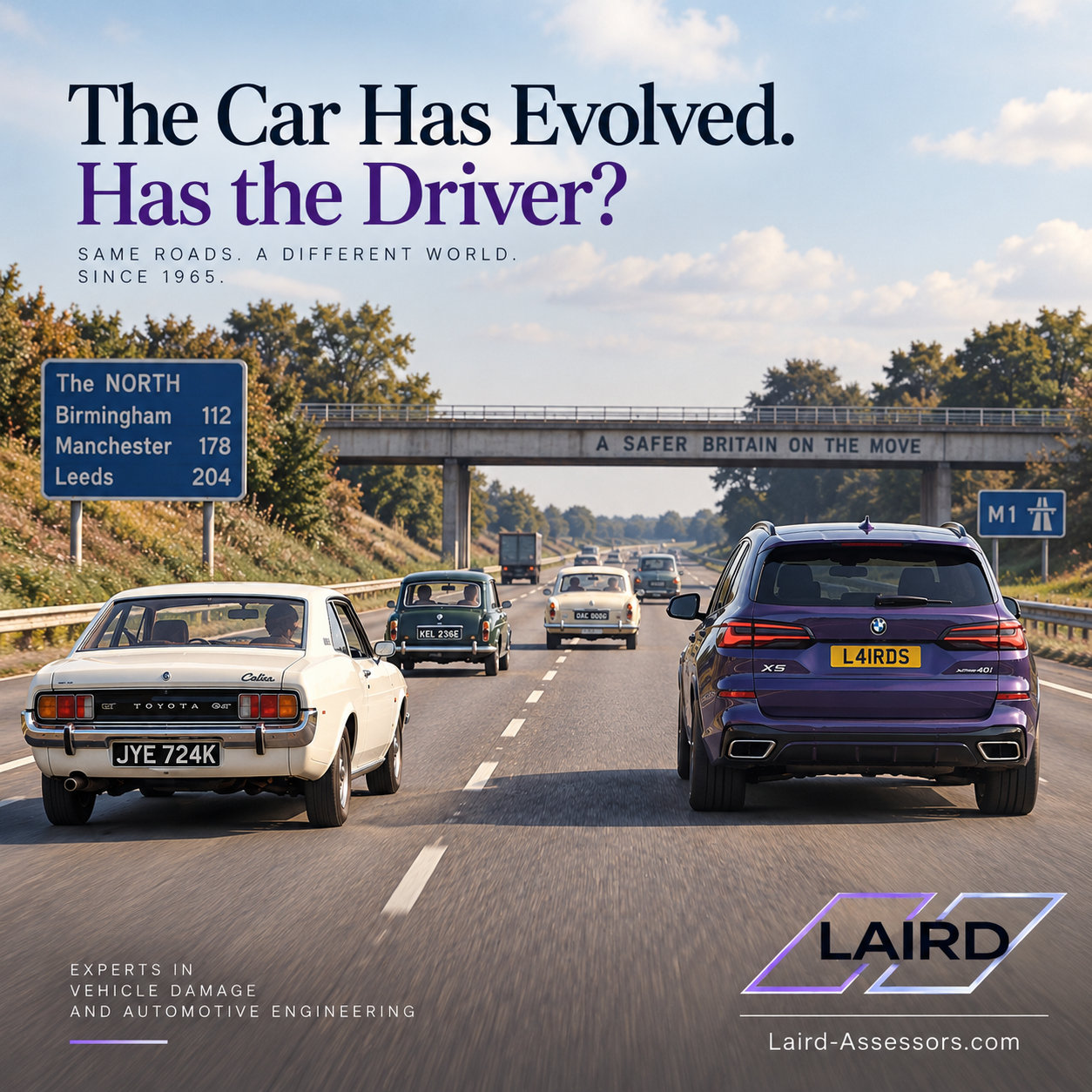
We have spent 60 years making cars better at 70 mph, but have we spent 60 years making drivers better at 70 mph?
Britain's 70 mph motorway speed limit was introduced experimentally in December 1965 and made permanent in 1967. Consider what has happened to the car since then.
A typical family car of the mid-1960s had narrow, cross-ply tyres, rudimentary suspension, modest braking performance and none of the electronic systems we now take for granted. There was no ABS, electronic stability control, traction control, autonomous emergency braking, adaptive cruise control, lane assistance or sophisticated crash protection. The modern equivalent is almost another species.
Tyres, brakes, suspension, structural engineering and passive safety have advanced enormously. Increasingly, the car is also watching the road, monitoring the driver and, in some circumstances, braking or steering before the person behind the wheel does. But what about the driver?
The machine has changed considerably. The basic qualification has changed rather less
Until June 2018, learner drivers weren't even permitted on British motorways. They can now receive motorway tuition, but only with an approved driving instructor in a dual-control car. Crucially, motorway lessons remain voluntary and motorway driving itself was not added to the practical driving test.
The official learning syllabus is broader than is sometimes appreciated. It covers emergency stopping, vehicle stability and an understanding of understeer and oversteer, but understanding something in theory is very different from experiencing it. You can watch a tonne of YouTube tutorials on swimming but I wouldn't advise jumping straight in the deep end!
A newly qualified driver does not normally have to demonstrate what happens when a car becomes unsettled at any speeds, urban to motorway. They don't have to experience understeer or oversteer and recover from it. They aren't routinely taught what approaching the limit of adhesion actually feels like, or what happens when grip suddenly changes.
For most motorists, we understandably teach them how not to get into trouble. Perhaps we should ask whether we do enough to teach them what to do when trouble nevertheless arrives, as demonstrated by the huge recovery, bodyshop, accident management & insurance industries.
The safety paradox
Modern cars are unquestionably capable of protecting us from situations that would once have resulted in a collision; a remarkable achievement, but it creates an interesting human-factor question: as the car becomes more capable, does the driver inevitably become less involved?
Adaptive cruise maintains distance. Lane assistance watches road position. Blind-spot monitoring watches alongside us. Parking sensors and cameras increasingly replace judgement of the extremities of the vehicle. Stability control can correct a developing loss of control before many drivers even realise it has happened, plus autonomous emergency braking can intervene when we don't.
The Department for Transport itself acknowledged the issue this year when considering further mandatory vehicle safety technology. Among the concerns raised were that some systems could reduce driver engagement and encourage over-reliance on automation, alongside concerns about how systems behave in poor weather or where road markings are inadequate. There is a potential paradox here.
The safer we make the car, the less opportunity the driver has to understand what it is saving them from.
When did you last feel ABS working?
There was a time when an inexperienced driver discovered quite quickly that braking hard, cornering aggressively or applying power badly could produce consequences. Modern electronics frequently intervene long before that point becomes obvious. Clearly that's what we want & I'm not suggesting switching them off.
However, ask an ordinary driver what ABS actually feels like through the pedal, what understeer feels like through the steering wheel, how weight transfer affects a car during an emergency manoeuvre, or what they should do when a car begins to rotate unexpectedly. How many could confidently answer?
More importantly, how many have ever been safely put into that situation during their training? If it's the standard driving test, Roadcraft-style training, IAM, RoSPA, etc then they will not have covered this.
Performance and motorsport tuition takes a different approach. It doesn't merely teach somebody to travel faster. Good instruction teaches vehicle dynamics: vision, weight transfer, braking, grip, balance, understeer, oversteer and what the vehicle is communicating as it approaches its limits.
I'm not saying that our driving tests should become a racing school, but there is an interesting principle underneath it.
Competence isn't simply the ability to operate a vehicle when everything is going correctly. It is also the ability to recognise when something is beginning to go wrong.
And ideally to recognise it early enough that recovery skills are never required.
Perhaps avoidance and recovery belong together
The hierarchy should probably be:
Anticipate. Assess. Avoid. Control. Recover.
Good observation and anticipation remain far more important than heroic car control. A driver who repeatedly needs to recover a sliding vehicle isn't demonstrating advanced driving; they're probably demonstrating poor judgement.
There is also a legitimate concern that teaching recovery skills in isolation could make some drivers more confident without making their judgement proportionately better. In my opinion a good argument for teaching the skills in the right order.
Teach drivers to recognise diminishing grip. Teach them why braking while cornering can destabilise a vehicle. Let them safely experience ABS. Demonstrate the difference between understeer and oversteer & the difference with front, rear and four wheel drive cars. Explain what stability control is actually doing when it intervenes. We need to teach them the limitations of the increasingly sophisticated systems surrounding them.
A driving licence lasts a long time
Perhaps the strangest part of the system is what happens after the test. For many motorists, pretty much nothing.
Someone can pass their test as a teenager in a little hatchback and, subject to retaining their licence and meeting the relevant requirements, continue driving for decades without ever having their practical ability formally reassessed.
During those decades the vehicle changes enormously; the roads, traffic density changes, technology changes, and even the driver changes too. Yet we largely regard the original test as sufficient evidence of continuing competence.
There are advanced driving schemes and additional training available, of course, but for the overwhelming majority of motorists, advanced training is optional, and very rarely taken, rather than a normal progression in becoming a more capable driver.
That seems unusual when compared with other activities where operating increasingly capable machinery carries significant responsibility.
We may be solving the wrong side of the equation
The direction of travel in automotive safety is clear; more sensors, more intervention, more automation, and more technology between the driver's input and the vehicle's response. Some of it will save lives, but there is another side to road safety that technology cannot entirely replace: judgement.
Knowing that 70 mph may be perfectly reasonable in one set of circumstances and completely inappropriate in another. Recognising the closing speed of traffic ahead before autonomous emergency braking becomes relevant.
Understanding that four-wheel drive can help a vehicle accelerate on a slippery surface but doesn't magically increase the tyre's available grip when it needs to stop.
Knowing when an assistance system can be trusted, when it is approaching its limitations and, critically, when the driver needs to take over.
These aren't even particularly exotic driving skills. They're an understanding of the machine being operated.
Perhaps the next breakthrough isn't another sensor
We have transformed the motor car since Britain first experimented with a 70 mph limit in 1965.
We have engineered out countless weaknesses and made vehicles enormously more forgiving of mistakes, and increasingly we are designing technology capable of recognising those mistakes before the driver does.
Perhaps that's precisely why the next conversation about road safety shouldn't only be about what else the car can do. It should also be about what we expect from the person driving it, because eventually every safety system reaches its limit. When it does, there is still a human being sitting behind the wheel.
The car has evolved. Perhaps it's time driver training evolved with it.