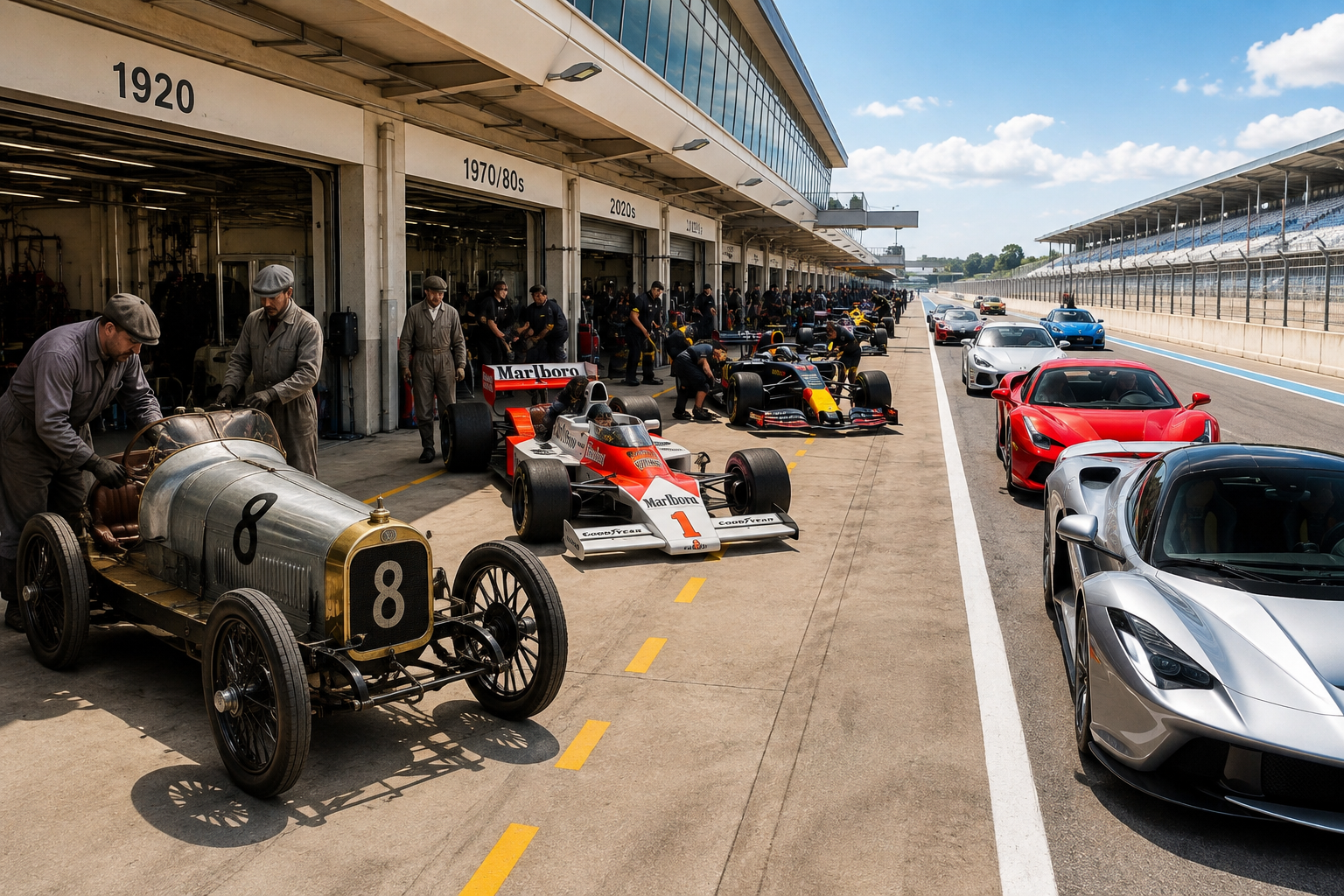
For more than a century, motorsport has been an unusually effective engineering laboratory.
The incentive is fairly obvious: make something lighter, faster, stronger or more controllable than the opposition and you might win. Get it wrong and the stopwatch will expose you very quickly.
Not every technology we associate with racing was invented in a pit garage. Aerospace, military engineering and conventional vehicle development have all fed ideas into motorsport. But racing has repeatedly taken emerging technology, subjected it to fairly brutal real-world testing, developed it at extraordinary speed and, eventually, helped it find its way into the cars we drive.
Occasionally the technology became so effective that the sport subsequently banned it.
Here are some of the best examples:
Disc brakes: stopping became as important as going
It is easy to forget how revolutionary the modern disc brake once was. Drum brakes were the norm when Jaguar began developing disc brakes with Dunlop for its C-Type racing programme in the early 1950s. The problem Jaguar was trying to solve was very much a racing one: repeated heavy braking from high speeds caused drum brakes to overheat and lose effectiveness.
In June 1952, Stirling Moss drove a disc-braked C-Type to victory at Reims, the first international motor race won by a car equipped with disc brakes. A year later, disc-braked C-Types dominated Le Mans, finishing first, second and fourth. Jaguar itself credits that success with helping drive much wider adoption of disc brakes in both racing and road cars.
Disc brakes were not purely a motorsport invention, but competition demonstrated their advantage rather dramatically.
Today, of course, they are so ordinary that their motorsport origins are easily overlooked. Even a modest family hatchback now possesses braking performance and fade resistance that would have seemed remarkable in the early 1950s.
Carbon fibre: from Formula 1 experiment to road-car structure
Carbon fibre already existed in aerospace before Formula 1 got hold of it. What McLaren did in 1981 was take a considerable leap of faith and build the main structure of an F1 car from it.
The McLaren MP4/1 became the first Formula 1 car with a full carbon-composite monocoque. Designer John Barnard recognised that carbon fibre could deliver the combination racing engineers dream about: very low weight, enormous stiffness and exceptional strength.
There were plenty of sceptics.
Then John Watson crashed an MP4/1 heavily at Monza. The engine and gearbox were torn from the car, but the carbon survival structure remained intact and Watson walked away. Suddenly the safety benefits were every bit as interesting as the performance advantage.
The rest of Formula 1 quickly followed.
McLaren then took the same philosophy onto the road. Its 1992 McLaren F1 became what McLaren describes as the world's first fully composite road car. Carbon tubs subsequently spread through the supercar and hypercar world and are now found in road cars from numerous manufacturers.
They also create an interesting modern repair problem. A damaged carbon structure cannot necessarily be approached in the same way as a conventional steel or aluminium panel. Knowing what the vehicle is made from is increasingly as important as knowing what shape it should be.
Paddle-shift gearboxes: Ferrari removes the gearlever
One of the clearest examples of a direct racetrack-to-road journey arrived in 1989.
Ferrari's 640 Formula 1 car introduced the first semi-automatic paddle-shift gearbox in F1. Instead of removing a hand from the steering wheel, operating a clutch and moving a conventional gearlever, the driver could request shifts using paddles behind the wheel while electrohydraulic actuators did the mechanical work.
It sounded worryingly complicated at the time. It was also initially rather unreliable.
Then Nigel Mansell won the 640's very first race, the 1989 Brazilian Grand Prix.
By the middle of the 1990s, the idea had spread throughout Formula 1.
Ferrari then began transferring the principle to its road cars, ultimately turning the steering-wheel paddle into a defining feature of the modern performance car.
Today you will find paddles behind the steering wheel of everything from supercars to diesel SUVs.
Very few of their drivers probably realise they are playing with technology that once looked radical enough for rival F1 teams to wonder whether Ferrari would even finish the race.
Dual-clutch transmissions: tested the hard way
The dual-clutch transmission followed a slightly different path.
Porsche developed its PDK system extensively through its motorsport programme during the 1980s, testing it in the 956 and later racing it in the enormously successful 962.
The principle is clever. Divide the gears between two separate transmission paths and two clutches. While one gear is driving the car, the next can effectively be prepared in advance. Swap clutches and the next ratio arrives with little interruption in power.
The early versions were heavy, complicated and hard on components. Which is precisely why endurance racing was such a useful development environment.
Porsche tested PDK in the 956 from 1984, raced increasingly successful versions in the 962 and demonstrated its potential at the highest level of sports-car racing.
Technology eventually caught up with the idea. Electronics, hydraulics and clutch control became sufficiently sophisticated for everyday use and, in 2008, Porsche introduced PDK into series-production 911 models. Similar dual-clutch transmissions subsequently became commonplace across the motor industry.
What had once been an exotic racing gearbox became something you could find in a Golf.
Ground effect: so effective Formula 1 banned it
Aerodynamics provides some of motorsport's most entertaining engineering stories.
The Lotus 78 arrived in Formula 1 in 1977 with a radically different way of creating downforce.
Rather than relying principally on wings pushing the car down from above, Lotus shaped the underside of the car to accelerate airflow and create a low-pressure area beneath it. The whole vehicle effectively became an inverted wing.
The Lotus 79 developed the idea further and helped Mario Andretti win the 1978 World Championship. Rival teams rapidly copied it and cornering speeds climbed dramatically.
Eventually the technology became rather too successful. For 1983, regulations mandated flat bottoms and effectively outlawed the extreme ground-effect cars of the period amid concern about their enormous cornering speeds and the consequences when the aerodynamic seal was suddenly lost.
The principle never disappeared. Modern performance road cars increasingly use carefully shaped floors, diffusers and venturi tunnels to generate downforce without the drag of enormous wings. Porsche explicitly identifies ground-effect development on its 956 and 962 racing cars as technology that subsequently appeared on its production cars.
And, in a neat historical twist, Formula 1 itself brought shaped underfloors and much greater reliance on ground effect back under its 2022 regulations.
Sometimes a good idea simply has to wait for the rulebook to catch up.
Active suspension: brilliant, complicated and banned
The Williams FW14B of 1992 has become one of the most famous technologically advanced racing cars ever built.
Its active suspension could alter the car's ride height and attitude rather than simply allowing springs and dampers to react passively to the road.
That meant the aerodynamic platform could be kept much closer to its ideal position during braking, acceleration and cornering. Williams could even alter the car's attitude on straights to reduce aerodynamic drag.
The concept itself had roots outside motorsport and Lotus had already experimented with active suspension in Formula 1 during the 1980s. Williams, however, exploited its potential spectacularly.
By 1993, Formula 1 cars were becoming rolling computers incorporating active suspension, traction control, anti-lock braking and other electronic driver aids.
For 1994, active suspension and several of those systems were banned. Cost, complexity and the increasingly dominant role of electronics had become a concern.
Road-car development went in precisely the opposite direction.
Modern active and semi-active suspension systems can continuously adjust individual dampers, control roll and pitch and alter ride height according to speed and conditions. Current production cars from Ferrari and Mercedes-Benz use sophisticated active chassis systems that would have sounded distinctly Formula 1-like a few decades ago.
Formula 1 decided it was too much. Road-car engineers decided it was rather useful.
Hybrid energy recovery: performance rather than simply economy
Hybrid cars did not originate in Formula 1, but motorsport helped demonstrate that electrification was not simply about saving fuel.
Formula 1 introduced Kinetic Energy Recovery Systems, or KERS, in 2009. Energy normally lost during braking could be recovered, stored and then redeployed to accelerate the car.
For performance manufacturers, that changed the conversation.
Ferrari subsequently transferred knowledge from its Formula 1 HY-KERS programme into LaFerrari. Ferrari itself describes the 2013 LaFerrari as its first road-going hybrid and explicitly links its system to the technology developed by Scuderia Ferrari.
That philosophy now runs through the performance-car industry.
Electric motors can fill gaps in an engine's torque curve, provide instantaneous acceleration, recover energy under braking and allow extraordinarily sophisticated control of how power reaches the road.
The electric motor ceased to be merely an efficiency device. Motorsport helped make it a performance component.
The fan car: banned on Sunday, road legal decades later
And then there are the ideas that refuse to die.
Gordon Murray's Brabham BT46B appeared at the 1978 Swedish Grand Prix with a huge fan at the rear. The fan helped create low pressure beneath the car, dramatically increasing its ground effect.
Niki Lauda won the race. The car never raced in Formula 1 again.
Although often described as being "banned", the story is slightly more nuanced: after protests and political pressure, Brabham voluntarily withdrew the BT46B after its single victory.
More than four decades later, Gordon Murray returned to the idea for a road car. His GMA T.50 uses a 400mm rear-mounted fan to manipulate airflow beneath the car and enhance its ground-effect aerodynamics.
A concept considered too controversial for Formula 1 in 1978 therefore ended up on a road-legal supercar. You couldn't really ask for a better example of racing technology completing the circle.
Motorsport's real contribution
The relationship between racing and road cars is rarely as simple as somebody inventing a component on Saturday and fitting it to a family saloon on Monday.
The more important contribution is development.
Racing gives engineers an extreme environment in which weight, temperature, reliability, aerodynamics, braking, efficiency and control can be measured relentlessly. Weak ideas tend to disappear quickly. Good ones get refined at extraordinary speed.
Disc brakes, carbon composite structures, paddle shifts, dual-clutch transmissions, active chassis technology, underbody aerodynamics and high-performance hybrid systems all demonstrate the same basic principle.
Today's exotic racing technology has a habit of becoming tomorrow's ordinary road-car engineering.
And from an assessor's point of view, that progression matters. A seemingly conventional modern vehicle can now contain composite structures, active dampers, complex underfloor aerodynamic components, electronically controlled transmissions and high-voltage hybrid systems that would once have been found only in competition cars.
The racetrack may be where engineers chase fractions of a second. A few years later, we often find ourselves assessing the results.